
Atlantic City
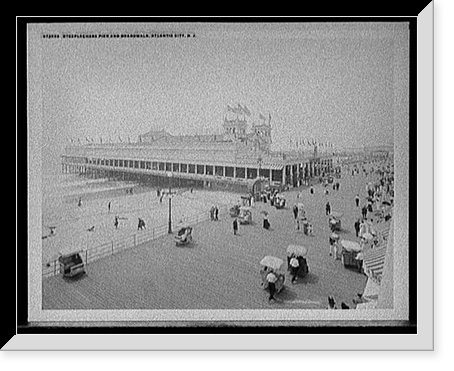
Atlantic City was not a town that grew into a resort. It was a resort laid out on an empty barrier island because a railroad wanted somewhere to carry people to.
The line from Camden opened in 1854 and put Philadelphia about two hours away. Everything in these photographs follows from that. By the 1880s a second railroad was competing on the same run and the fares dropped low enough that a day at the shore became an ordinary thing for a working family rather than a luxury.
The boardwalk came in 1870 and the reason for it is entirely practical. Sand tracked off the beach was ruining hotel carpets and railroad car floors, so a temporary wooden walk was laid down each summer and taken up each fall. It worked, it got permanent, and it got wider and longer through five successive rebuilds until it ran several miles. It is the first structure of its kind anywhere, and the word itself starts here.
The rolling chairs date from 1887 — wicker chairs on wheels, pushed by an attendant, rented by the hour. They fill the foreground of a great many boardwalk photographs and they were as much about being seen as about getting anywhere.
The piers pushed the whole business out over the water. Steel Pier opened in 1898 and ran for a thousand feet with theaters, ballrooms, and eventually a horse that dove into a tank from a platform forty feet up. Million Dollar Pier, Steeplechase Pier, and the Heinz Pier with its free pickle pin all belong to the same stretch of years.
The Miss America pageant started in September 1921 and the motive was commercial rather than ceremonial. Business owners wanted a reason for visitors to stay past Labor Day, so they invented an event for the week after it. It worked, and the pageant ran in the city for most of the following century.
One last thing these photographs quietly explain. Charles Darrow laid the Monopoly board out on Atlantic City street names in the 1930s — Boardwalk, Park Place, Ventnor, Marven Gardens, which the game misspells. The board is a rough map of the town as it stood in these pictures, with the beachfront properties at the expensive end and the streets inland cheap.
The Railroad Called It America’s Switzerland



-

 Snapshots of the Past
Vintage Photo Print - Atlantic City - Bathing hour, N.J (2)
Step back in time with this striking reproduction of German Bomb - proof shelter, 5 yds deep. Sourced from the United States Library of Congress.Library of Congress record: Title from unverified data...$57.00 -
 Snapshots of the Past
Vintage Landscape - Atlantic City - Bathing beach, N.J (2)
This rare historical print captures Percy Peck in remarkable detail. Sourced directly from the Library of Congress, it represents an authentic piece of documented history.Library of Congress record:...$57.00 -
 Snapshots of the Past
Antique Architecture - Atlantic City - St. James Episcopal Church, N.J
This rare historical print captures Mrs. W. Astor Chanler, Theo, & Wm. Classic in remarkable detail. Sourced directly from the Library of Congress, it represents an authentic piece of documented...$57.00 -
 Snapshots of the Past
Antique Photo Print - Atlantic City - Sand modelling, N.J
Step back in time with this striking reproduction of Gen. Castelnau. Sourced from the United States Library of Congress.Library of Congress record: Title from unverified data provided by the Bain...$57.00 -
 Snapshots of the Past
Antique City View - Atlantic City - Atlantic Avenue, N.J (2)
Drawn from the Library of Congress archive, this print depicts Xmas Tree, Madison Sq., 1915 Classic. The Library holds one of the most comprehensive collections of American and international...$57.00 -
 Snapshots of the Past
Vintage Landscape - Atlantic City - Bathing beach, N.J (1)
This rare historical print captures Field work, Tuskegee Classic in remarkable detail. Sourced directly from the Library of Congress, it represents an authentic piece of documented history.Library of...$57.00