General Stores
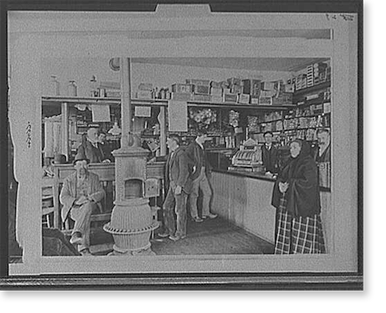
In thousands of American towns the general store held the post office, and that single fact explains everything else about it.
Fourth-class postmasterships were political appointments handed to a local merchant, who ran the mail window from a corner of his own store. Everyone in the district had to come in for their mail, which meant everyone came in regularly whether they intended to buy anything or not. The store did not have to attract traffic. The federal government delivered it.
The stock was everything at once because there was nothing else. Flour, salt, coffee, kerosene, nails, cloth by the yard, patent medicine, harness, boots, seed, tobacco and candy, arranged floor to ceiling with the heavy goods low and the rest reached with a pole. Almost nothing was packaged. Crackers came in a barrel, pickles in another, sugar and beans were scooped and weighed, and the clerk cut what you asked for from bulk.
The money was mostly not money. Farm families settled accounts seasonally, and in the meantime they traded what they had — eggs, butter, hides, ginseng, chickens. The store credited it against the ledger and resold it. Those ledgers are one of the better surviving records of rural household economy, because they list what an ordinary family actually bought, week by week, under their own name.
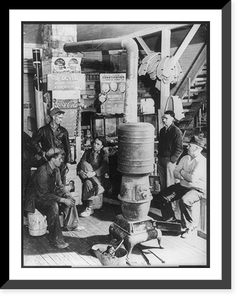
The stove and the chairs around it were the point of the room. A store was where a district learned news, argued politics, and waited out weather, and photographers recognized that — the interior shots with four men sitting near the stove and one leaning on the counter are showing a social institution rather than a business.
What killed it came through the mail. Montgomery Ward began in 1872 and Sears in 1893, both selling by catalog at prices the local store could not match, and both aimed squarely at the farm customer who resented paying credit-inflated prices. Rural free delivery from 1896 and parcel post from 1913 finished the job by bringing the goods to the door. Storekeepers organized against both, and in some towns held public burnings of catalogs. It did not work.
Automobiles did the rest. Once a farm family could drive to a county-seat town on a Saturday, the crossroads store had nothing left that a larger store could not do better.
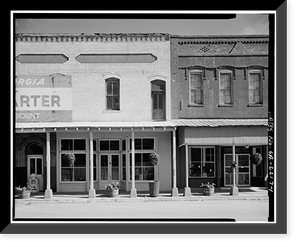
The porch is worth its own note. Nearly every one of these buildings had a covered front with benches, and it worked as the town’s public square — shaded, free, and not requiring anyone to buy anything. Photographers found the best groupings there, and a porch photograph will often tell you more about who lived in a district than the interior does.
The best photographs of these places were made as they ended. The Farm Security Administration sent Walker Evans, Marion Post Wolcott, Russell Lee and others across the country between 1935 and 1942, and they photographed store fronts, interiors and porches with unusual care. Those images are documentary rather than nostalgic, and the difference shows.
The Bird's-Eye View Was an Advertisement



-

 Snapshots of the Past
Historic Architecture - Amana, Iowa - Colonies General Store & Offices (2)
Originally preserved in the Library of Congress, this print of Amana Colonies General Store & Offices, State Route 220, Amana, Iowa County, IA - 2 is now available for your home or office. The...$57.00 -
 Snapshots of the Past
Historic Architecture - Amana, Iowa - Colonies General Store & Offices (1)
Drawn from the Library of Congress archive, this print depicts Amana Colonies General Store & Offices, State Route 220, Amana, Iowa County, IA Classic. The Library holds one of the most comprehensive...$57.00 -
 Snapshots of the Past
Historic Architecture - Plains, Georgia - Lunsford-French-Timmerman
Originally preserved in the Library of Congress, this print of Lunsford-French-Timmerman General Store, Main Street, Plains, Sumter County, GA Classic is now available for your home or office. The...$57.00 -
 Snapshots of the Past
Black & White Photo - Cordell - Edd Hull and 3 cousins around stove, 1871
Originally preserved in the Library of Congress, this print of Hull, Cordell 1871-1955 - Edd Hull and 3 cousins around stove in his general store at Armathwaite, Tenn. Classic is now available for...$57.00 -
 Snapshots of the Past
Vintage Photo Print - Westminster, Maryland - S.O. Grimes general store
Originally preserved in the Library of Congress, this print of Suffrage Shop - 2 is now available for your home or office. The Library has preserved this image as part of its permanent historical...$57.00