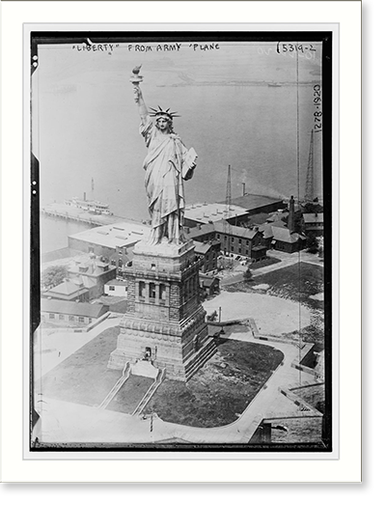
Statue of Liberty
The photographs people expect of the Statue of Liberty are the ones taken after 1886. The more interesting ones are earlier, and they show her in parts.
The torch and the raised arm were finished first and shipped to Philadelphia for the Centennial Exhibition in 1876. Afterward they sat in Madison Square Park in New York for six years, fenced off, with visitors paying to climb a ladder to the balcony around the flame. There are photographs of the arm standing in the park among ordinary buildings and bare trees, which is a genuinely strange image and one of the best things in the whole record.
The reason it sat there was money. France paid for the statue; the United States was supposed to pay for the pedestal and did not. The fundraising stalled badly enough that other cities offered to take her. Joseph Pulitzer finally ran a campaign in the New York World promising to print the name of every donor no matter how small, and about 120,000 people sent in what they had, mostly in coins. That is what built the base.
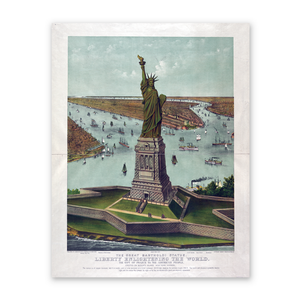
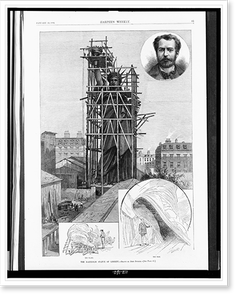
The rest of her arrived in 1885 aboard the French frigate Isere, packed in 214 crates. Assembly on Bedloe’s Island took months, and photographs from that period show the copper skin going on over Gustave Eiffel’s iron framework a plate at a time. The dedication was October 28, 1886, in fog and rain, with a boat parade and almost no women present — the organizers had limited attendance on the island, which prompted a suffrage protest by boat offshore.
The color in early accounts is not green. New copper is a dull brown, roughly the shade of a penny, and she stayed close to that for about twenty years before the patina finished spreading. Any hand-colored photograph showing her green in the 1880s is a later assumption painted onto an earlier picture.
For fifteen years she was officially a lighthouse. The Lighthouse Board ran her until 1901, and the torch carried an actual navigational light that was never much good at the job. Administration then passed to the War Department, and the island was a working army post — Fort Wood, whose eleven-pointed star fortification is the shape you can see underneath the pedestal in aerial photographs.
The torch has been closed to visitors since 1916, when the Black Tom munitions explosion across the water in Jersey City sent shrapnel into the arm. The island itself was called Bedloe’s until 1956, which is worth knowing when you read old captions.
The Park That Photographs Talked Congress Into



-

 Snapshots of the Past
Historic Framed Print Vintage Statue of Liberty Print - 4, 17-7/8" x 21-7/8"
Vintage Statue of Liberty Print - 4, 17-7/8" x 21-7/8" , Image: 16" x 20"Note: Some images may show issues such as color bars or other artifacts from the digital scanning process at the Library. We...$57.00 -
 Snapshots of the Past
Historic Framed Print Vintage Statue of Liberty Print - 3, 17-7/8" x 21-7/8"
Vintage Statue of Liberty Print - 3, 17-7/8" x 21-7/8" , Image: 16" x 20"Note: Some images may show issues such as color bars or other artifacts from the digital scanning process at the Library. We...$57.00 -
 Snapshots of the Past
Historic Framed Print Vintage Statue of Liberty Print - 2, 17-7/8" x 21-7/8"
Vintage Statue of Liberty Print - 2, 17-7/8" x 21-7/8" , Image: 16" x 20"Note: Some images may show issues such as color bars or other artifacts from the digital scanning process at the Library. We...$57.00 -
 Snapshots of the Past
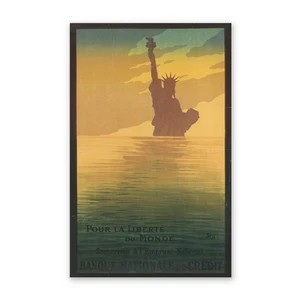
Historic Framed Print Vintage Statue of Liberty Print - 1, 17-7/8" x 21-7/8"
Vintage Statue of Liberty Print - 1, 17-7/8" x 21-7/8" , Image: 16" x 20"Note: Some images may show issues such as color bars or other artifacts from the digital scanning process at the Library. We...$57.00 -
 Snapshots of the Past
Vintage Portrait - Statue of Liberty - Woodrow Wilson
Step back in time with this striking reproduction of Woodrow Wilson, half-length portrait, standing, facing left, Statue of Liberty in background Classic. Sourced from the United States Library of...$57.00 -
 Snapshots of the Past
Historic Photo Print - New York City - Holland-America Line
This rare historical print captures Holland-America Line. Rotterdam-New York via Boulogne/sur mer and Southampton in remarkable detail. Sourced directly from the Library of Congress, it represents an...$57.00 -
 Snapshots of the Past
Historic Photo Print - Hello! This is liberty speaking
Step back in time with this striking reproduction of Hello! This is liberty speaking - billions of dollars are needed and needed now.Z.P. Nikolaki. - 2 Classic. Sourced from the United States Library...$57.00 -
 Snapshots of the Past
Antique Photo Print - Colossal hand and torch Liberty
This rare historical print captures Colossal hand and torch Liberty"" - 3 in remarkable detail. Sourced directly from the Library of Congress, it represents an authentic piece of documented history...$57.00 -
 Snapshots of the Past
Vintage Americana Print - Before sunset buy a U.S. government, 1917
Step back in time with this striking reproduction of Before sunset buy a U.S. government bond of the 2nd liberty loan of 1917.Eugenie De Land. - 2 Classic. Sourced from the United States Library of...$57.00 -
 Snapshots of the Past
Antique Architecture - New York City - view looking south
Step back in time with this striking reproduction of New York City, view looking south from the Empire State Building, lower New York skyline. Sourced from the United States Library of Congress...$57.00 -
 Snapshots of the Past
Vintage Photo Print - Statue of Liberty - The Bartholdi drawn by John
Originally preserved in the Library of Congress, this print of The Bartholdi Statue of Liberty.drawn by John Durkin is now available for your home or office. The Library has preserved this image as...$57.00 -
 Snapshots of the Past
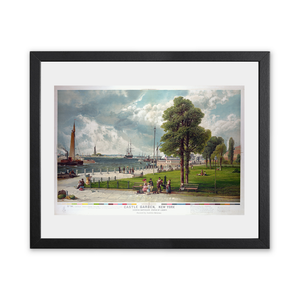
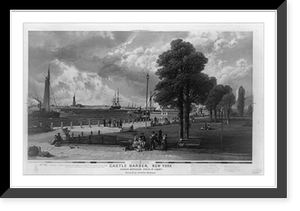
Historic Architecture - New York City - Castle Garden, New York
Originally preserved in the Library of Congress, this print of Castle Garden, New York, showing Bartholdi's Statue of Liberty.painted by Andrew Melrose. Classic is now available for your home or...$57.00