Vintage Stereoviews

A stereoview is two photographs of the same scene, taken a couple of inches apart, mounted side by side on a card. Looked at through a viewer, they merge into a single image with depth. It was the most popular form of photography in America for fifty years and almost nobody remembers it.
The principle was worked out in the 1830s, before photography was practical, by Charles Wheatstone, who established that depth perception comes from each eye receiving a slightly different image. Once photography arrived, making two exposures a few inches apart was obvious.
The device that made it a mass medium was designed by Oliver Wendell Holmes in 1861 — the physician and essayist, not his son the justice. He built a simple handheld viewer with a hood and a sliding card holder, and deliberately did not patent it, so anyone could manufacture one. Within a decade there was one in most middle-class American parlors.
The optical effect is worth explaining because it is easy to underrate. This was not a picture that looked deep — it genuinely produced depth, the same way two eyes do, and the reported experience was of standing in a place rather than looking at it. Nothing else in the nineteenth century did that.
What people looked at through them was the world. Publishers sent photographers to Egypt, Japan, the Holy Land, the Alps, the American West. They photographed disasters, wars, expositions, presidents, freak weather and street life. A family in Ohio in 1875 could look at the Pyramids in three dimensions, which no previous generation could do in any form.
Keystone View Company eventually absorbed most of its competitors and ended up holding the negatives of the entire American industry — something like two million images. It stayed in business selling educational sets to schools until the 1960s, decades after the parlor viewer had disappeared, which is why so many cards survive in good condition.
The commercial operations were enormous. Underwood & Underwood was producing something like twenty-five thousand cards a day at its peak and selling them door to door in boxed sets with printed guides, sold as education as much as entertainment.
The comic and sentimental cards are the other half of the trade and they were popular. Staged domestic scenes, courtship jokes, children with animals, mild slapstick — the same material a magazine cartoon would carry, in three dimensions.
The format died in the 1920s, killed by the picture magazine and then the cinema. It came back briefly as the View-Master in 1939, which is the same idea on a disc.
The western survey work is the most historically important use of the format. Timothy O’Sullivan, William Henry Jackson and others photographed the territorial surveys in stereo as well as in single frames, so the canyons and rock formations of the American West reached the eastern public in three dimensions before most of those places had names on a federal map.
For dating, the mount is the guide. Flat cards with square corners are generally 1850s to 1870s. Curved cards with rounded corners come in during the 1880s and after — the curve was introduced to improve the stereo effect. Yellow, orange and grey mounts each belong to particular publishers and periods.
Posters Printed to Be Destroyed




-

 Snapshots of the Past
Historic Stereoview - Aibonita Heights from the Military Road Puerto
Drawn from the Library of Congress archive, this print depicts Aibonita Heights from the Military Road Puerto Rico. The Library holds one of the most comprehensive collections of American and...$57.00 -
 Snapshots of the Past
Historic Stereoview - et weaving - a Hopi Indian at work Wolpei (Walpi)
Drawn from the Library of Congress archive, this print depicts et weaving - a Hopi Indian at work Wolpei (i.e. Walpi) Arizona. The Library holds one of the most comprehensive collections of American...$57.00 -
 Snapshots of the Past
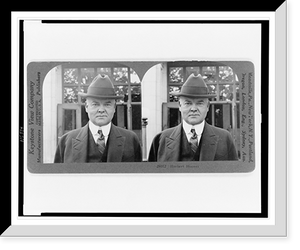
Vintage Stereoview - President Herbert Hoover bust portrait facing front
Drawn from the Library of Congress archive, this print depicts President Herbert Hoover bust portrait facing front. The Library holds one of the most comprehensive collections of American and...$57.00 -
 Snapshots of the Past
Vintage Stereoview - Florida - The old slave market - St. Augustine
This rare historical print captures Florida - The old slave market sic - St. Augustine Classic in remarkable detail. Sourced directly from the Library of Congress, it represents an authentic piece of...$57.00 -
 Snapshots of the Past
Vintage Stereoview - Stretching and drying loft. Underwood & Underwood
Step back in time with this striking reproduction of Stretching and drying loft. Underwood & Underwood. Sourced from the United States Library of Congress.Library of Congress record: Created 1915...$57.00 -
 Snapshots of the Past
Vintage Stereoview - Three Winnebago men full-length portraits seated
Drawn from the Library of Congress archive, this print depicts Three Winnebago men full-length portraits seated facing front. photograph by W.H. Illingworth. The Library holds one of the most...$57.00 -
 Snapshots of the Past
Antique Stereograph - Skirmishing near the monasteries in the air
Step back in time with this striking reproduction of Skirmishing near the monasteries in the air northern Greece. Sourced from the United States Library of Congress.Library of Congress record:...$57.00 -
 Snapshots of the Past
Historic Stereoview - On Dyea Trail Alaska - Antique Wall Decor Print
Step back in time with this striking reproduction of On Dyea Trail Alaska. Sourced from the United States Library of Congress.Library of Congress record: Created 1898 36250 U.S. Copyright Office...$57.00 -
 Snapshots of the Past
Vintage Stereoview - Gold mines Bendigo Vict. Australia
Drawn from the Library of Congress archive, this print depicts Gold mines Bendigo Vict. Australia. The Library holds one of the most comprehensive collections of American and international historical...$57.00 -
 Snapshots of the Past
Antique Stereograph - Mother of the forest (90 ft.)
This rare historical print captures Mother of the forest (90 ft.). sacrificed to curiosity. died when bark (now in London) was stripped for exhibition Calaveras Grove Cal in remarkable detail...$57.00 -
 Snapshots of the Past
Historic Stereoview - Devils Pulpit Geysers Sonoma County Cal
Originally preserved in the Library of Congress, this print of Devils Pulpit Geysers Sonoma County Cal. Andrew Price photographer is now available for your home or office. The Library has preserved...$57.00 -
 Snapshots of the Past
Vintage Stereoview - Battle-field of Gettysburg - Antique Wall Decor Print
Drawn from the Library of Congress archive, this print depicts Battle-field of Gettysburg - Union breast works on Culps Hill temporarily taken by the Rebels. The Library holds one of the most...$57.00