
Lincoln Memorial
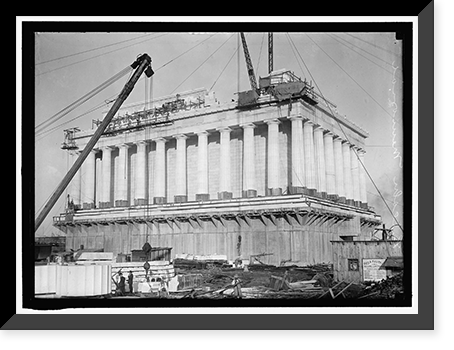
Congress first proposed a memorial to Lincoln in 1867, two years after his death. It was dedicated in 1922. The fifty-seven years in between were spent arguing.
The arguments were about site as much as design. The chosen ground was reclaimed swamp at the far west end of the Mall, and Speaker Joseph Cannon said he would never let a memorial to Lincoln be erected in that God-damned swamp. He lost, and the site turned out to be the most important thing about the building.
Henry Bacon designed it as a Greek temple, which was a deliberate argument \u2014 a democracy honoring the man who preserved it, in the architecture of the first democracy. Thirty-six columns for the thirty-six states at Lincoln\u2019s death, with their names above, and the states existing at completion listed on the attic above that.
Daniel Chester French made the statue and it is nineteen feet high, which was not the original plan. French built a ten-foot version, saw it in the chamber and realized it would be lost in the space, and enlarged it. It was carved from twenty-eight blocks of Georgia marble by the Piccirilli brothers of the Bronx, six Italian-born carvers who executed a great deal of America\u2019s public sculpture and are almost never credited.
The dedication in 1922 is worth knowing about. The audience was segregated. Robert Moton, the president of Tuskegee, was the only Black speaker, was made to sit in a roped-off section across a road after speaking, and had his prepared address censored for being too direct about lynching and disenfranchisement.
What the building became afterward is the reason it matters. Marian Anderson sang there in 1939 after being refused Constitution Hall, to seventy-five thousand people. The March on Washington in 1963 ended on those steps. The site that was chosen by accident of drainage turned into the place where the country argues with itself about what Lincoln meant.
The construction photographs are worth seeking out \u2014 the columns going up in drums, the statue being assembled inside the finished chamber, and the Reflecting Pool being dug.
The inscriptions are part of the design and were argued over as much as the building. The Gettysburg Address is carved on the south wall and the Second Inaugural on the north, so a visitor stands between the two speeches with the statue between them. There is a mistake in the Second Inaugural carving — an E cut where an F belonged, corrected in the stone but still visible.
The reflecting pool came later and was not in the original scheme. It was added in 1922 and 1923, more than half a mile long, and it is the reason the memorial photographs the way it does. Most of the well-known images depend on it entirely.
Daniel Chester French was deaf in one ear and had a lifelong preoccupation with hands. The statue’s hands are the part sculptors talk about — one closed, one open, taken from a life cast French had made of his own — and they carry most of what the figure is saying.
The Cottages Were Not Cottages




-

 Snapshots of the Past
Antique Architecture - Lincoln Memorial - West Potomac Park (1)
Drawn from the Library of Congress archive, this print depicts Lincoln Memorial, West Potomac Park, Washington, District of Columbia, DC - 227. The Library holds one of the most comprehensive...$57.00 -
 Snapshots of the Past
Antique Architecture - Lincoln Memorial - West Potomac Park (4)
Originally preserved in the Library of Congress, this print of Lincoln Memorial, West Potomac Park, Washington, District of Columbia, DC - 195 is now available for your home or office. The Library...$57.00 -
 Snapshots of the Past
Antique Architecture - Lincoln Memorial - West Potomac Park (3)
Step back in time with this striking reproduction of Lincoln Memorial, West Potomac Park, Washington, District of Columbia, DC - 56. Sourced from the United States Library of Congress.Library of...$57.00 -
 Snapshots of the Past
Antique Architecture - Lincoln Memorial - West Potomac Park (2)
Step back in time with this striking reproduction of Lincoln Memorial, West Potomac Park, Washington, District of Columbia, DC - 7. Sourced from the United States Library of Congress.Library of...$57.00 -
 Snapshots of the Past
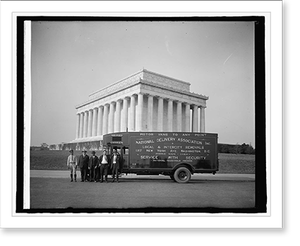
Vintage Photo Print - Washington, DC - National Delivery Association
Drawn from the Library of Congress archive, this print depicts National Delivery Association, Lincoln memorial, Washington, D.C. The Library holds one of the most comprehensive collections of...$57.00 -
 Snapshots of the Past
Historic Photo Print - Washington DC - Lincoln Memorial, Washington
Originally preserved in the Library of Congress, this print of Lincoln Memorial, Washington, D.C., corner stone laying - 2 is now available for your home or office. The Library has preserved this...$57.00 -
 Snapshots of the Past
Vintage Photo Print - Washington DC - Lincoln Memorial, Washington
Step back in time with this striking reproduction of Lincoln Memorial, Washington, D.C., under const. Sourced from the United States Library of Congress.Library of Congress record: Created between...$57.00 -
 Snapshots of the Past
Antique Photo Print - Washington, DC - Lincoln Memorial (4)
Step back in time with this striking reproduction of Lincoln Memorial, Washington, D.C. - 9. Sourced from the United States Library of Congress.Library of Congress record: Created between 1910 and...$57.00 -
 Snapshots of the Past
Antique Photo Print - Washington, DC - Lincoln Memorial (3)
This rare historical print captures Lincoln Memorial, Washington, D.C. - 8 in remarkable detail. Sourced directly from the Library of Congress, it represents an authentic piece of documented history...$57.00 -
 Snapshots of the Past
Vintage Americana Print - Washington, DC - Lincoln Statue
Originally preserved in the Library of Congress, this print of Lincoln Statue, Lincoln Memorial, Washington, D.C is now available for your home or office. The Library has preserved this image as part...$57.00 -
 Snapshots of the Past
Vintage Americana Print - Washington, DC - Wescott coupe in front
Originally preserved in the Library of Congress, this print of Wescott coupe in front of Lincoln memorial, Washington, D.C. - 2 is now available for your home or office. The Library has preserved...$57.00 -
 Snapshots of the Past
Vintage Photo Print - Lincoln Memorial - Col. Sherrill & Capt
Drawn from the Library of Congress archive, this print depicts Col. Sherrill & Capt. A.A. Andrews turning on Rainbow Fountain at Lincoln Memorial, 10/1. The Library holds one of the most...$57.00