Military
The American military photographic record begins with a business failure. Mathew Brady equipped and financed some twenty photographers to follow the Union armies, expecting the government to buy the collection afterward. It did not, and he went bankrupt. The men who did the actual work in the field — Alexander Gardner, Timothy O’Sullivan, George Barnard — were credited as Brady employees for decades before their own names came back into the record.
Wet-plate photography could not capture motion. Every Civil War photograph is therefore of something that held still: camps, fortifications, ordnance, officers posed at headquarters, ships at anchor, and the aftermath of a battle rather than the battle. Understanding that explains the shape of the whole collection. There are thousands of images of men doing nothing, because doing nothing is what the camera could record, and those turn out to be a better account of soldiering than any action picture would have been.
The Spanish-American War in 1898 is the first conflict with fast enough materials to catch movement, and it is also the first heavily covered by illustrated newspapers competing for circulation. The camps at Tampa and Chickamauga, where far more men died of typhoid than of Spanish bullets, are extensively photographed.
The First World War was photographed under a system. The Signal Corps trained and deployed official photographers, roughly a couple of thousand men, and everything they made went through censorship review before release. Private cameras were prohibited at the front, which is why almost no American soldier snapshots exist from France and why the surviving imagery has a uniform, official quality. American photographs of American dead were not published at all during that war.
Photographs of Black regiments require a note. Units served in every one of these wars under white officers and in segregated formations, and the official record photographed them unevenly — heavily when it suited a recruiting purpose and barely otherwise. What survives is worth seeking out precisely because the gaps in it were deliberate.
The home front is where the volume is. Liberty Loan parades, Red Cross workrooms, canteens, shipyards, women in munitions plants, training camps built from nothing in a few months at Ayer, Devens and Upton. Whole towns turned out to see local companies off, and the departures were photographed as civic events.
The Second World War changed the rules again. Photographs of American dead were withheld until 1943, when the government reversed itself and permitted them specifically because officials feared the public had grown complacent. That decision is visible in the record — the imagery from 1943 onward is markedly harder than what came before it.
Bands, mascots and baseball teams turn up constantly in camp photographs and they are not incidental. Every regiment of any size had a band, most had a mascot animal that appears in the formal portraits, and organized athletics filled the enormous quantity of time between drills. A unit photograph with a dog in the front row is following a convention, not an accident.
Two notes for anyone working with this material. Unit identifications on camp photographs are often wrong, because prints circulated among soldiers who wrote their own captions years later. And the ship photographs are unusually reliable, because the Navy kept systematic records with dates and hull numbers.
Three Thousand Films That Survive Only as Paper


-

 Snapshots of the Past
Black & White Photo - Join the air service and serve in France
Drawn from the Library of Congress archive, this print depicts Join the air service and serve in France. Do it now.J. Paul Verrees. Classic. The Library holds one of the most comprehensive...$57.00 -
 Snapshots of the Past
Antique Maritime - Fight, let's go - Antique Wall Decor Print
This rare historical print captures Fight, let's go! Join the Navy.McClelland Barclay, USNR. - 2 in remarkable detail. Sourced directly from the Library of Congress, it represents an authentic piece...$57.00 -
 Snapshots of the Past
Vintage Nautical Print - The Navy is calling. Enlist now.L.N. Britton
Originally preserved in the Library of Congress, this print of The Navy is calling. Enlist now.L.N. Britton. Classic is now available for your home or office. The Library has preserved this image as...$57.00 -
 Snapshots of the Past
Historic Military - Official United States war films.Stoner
Historic Framed Print, Official United States war films.Stoner. - 2, 17-7/8" x 21-7/8", Image: 16" x 20"Beautiful historic reproduction print from the Library of Congress collections.Created New...$57.00 -
 Snapshots of the Past
Vintage Americana Print - Let's go! U.S. Marines
Historic Framed Print, Let's go! U.S. Marines, 17-7/8" x 21-7/8", Image: 16" x 20"Beautiful historic reproduction print from the Library of Congress collections.Created 1941 or 1942(?) Posters...$57.00 -
 Snapshots of the Past
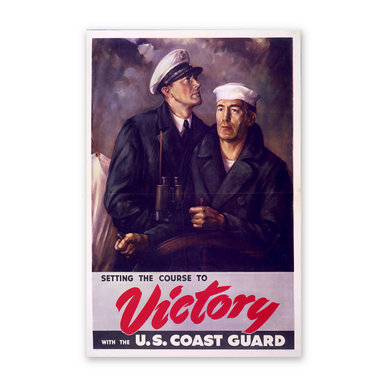
Historic Landscape - Setting the course to victory with the U.S. Coast
Historic Framed Print, Setting the course to victory with the U.S. Coast Guard.L.W. Bentley, U.S.C.C.R., 17-7/8" x 21-7/8", Image: 16" x 20"Beautiful historic reproduction print from the Library of...$57.00