Fourth of July
The most useful thing to know about Fourth of July photographs is that around 1910 the holiday changed character completely, and it changed because it was killing people.
Nineteenth-century Independence Day was celebrated with explosives handled by anybody who wanted them. Children fired blank cartridges from toy pistols, threw giant firecrackers, and set off homemade devices. The wounds became a recognized annual medical event, and the Journal of the American Medical Association began tracking the toll. The figures are hard to read even now: hundreds of deaths a year nationally, thousands of injuries, and the largest single cause was not burns or blast but tetanus, because blank cartridge wadding drove dirt and cloth deep into a wound. In 1903 the count ran to well over four hundred deaths.
The response was the Safe and Sane Fourth movement, which ran through the 1900s and 1910s and was led by women’s clubs, medical societies and municipal reformers. Cities banned private fireworks and replaced them with organized programs — parades, band concerts, athletic contests, historical pageants, community picnics and a single public fireworks display run by professionals at the end of the day.
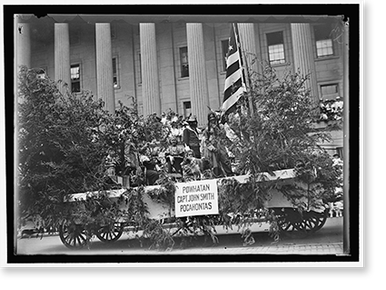
That is why so many Fourth of July photographs from the 1910s and 1920s show enormous civic events with everybody participating. Decorated bicycles and baby carriages in a children’s parade. Automobiles wrapped in bunting. Historical pageants with hundreds of townspeople in costume, staged on a hillside or a fairground. Those were built deliberately, to give people something to do with the day besides blow their hands off.
The other great Fourth of July subject is naturalization. Independence Day was the traditional occasion for public citizenship ceremonies, sometimes with hundreds of people sworn in at once at a park or a stadium, and Americanization programs of the 1910s and 1920s made a spectacle of it. There are photographs of the Ford English School graduation in which immigrant workers walked into a giant prop melting pot in their national dress and came out the other side in suits carrying small flags. That image is now used to criticize the era, and it was made at the time as a boast.
The bunting and flags themselves date pictures. Before an executive order in 1912 there was no official arrangement of the stars, so flags in nineteenth-century photographs show them in circles, ovals, one large star made of small ones, or simply scattered. A flag with an irregular star field is not a mistake by the photographer or a fake — it is a flag made before anyone standardized it.
Oratory belonged to the day as much as the noise did. A Fourth of July program through the nineteenth century meant a public reading of the Declaration and a long address from a local figure, and the platform draped in bunting with a crowd of several thousand standing in a field is a standard photograph of the period. Frederick Douglass gave his best-known speech on July 5, 1852, asking what the day meant to a slave, and the tradition of using the occasion to argue about the country is as old as the occasion.
Small towns are better represented here than cities. A Fourth of July parade down a main street of two-story brick storefronts, with a band, a fire company, veterans in uniform and children on decorated bicycles, is the single most common form of this photograph in any American archive, and the storefront signs behind the marchers usually date it faster than anything else in the frame.
The Card Trade That Grew Out of Long Convalescence


-

 Snapshots of the Past
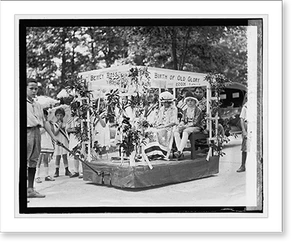
Vintage Landscape - Fourth of July - Takoma Park, celebration, 1923
This rare historical print captures Takoma Park, Fourth of July celebration, 7/4/23 - 3 in remarkable detail. Sourced directly from the Library of Congress, it represents an authentic piece of...$57.00 -
 Snapshots of the Past
Vintage Photo Print - Fourth of July - The pic nic on the A day
Step back in time with this striking reproduction of The pic nic on the fourth of July A day to be remembered".painted by Lilly M. Spencer ; engraved by Saml. Hollyer & J. Rogers." - 3. Sourced from...$57.00 -
 Snapshots of the Past
Black & White Photo - Fourth of July - Independence Day
Originally preserved in the Library of Congress, this print of Independence Day - 1964 is now available for your home or office. The Library has preserved this image as part of its permanent...$57.00 -
 Snapshots of the Past
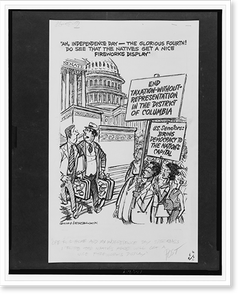
Antique Photo Print - Fourth of July - Ah, Independence Day
Originally preserved in the Library of Congress, this print of Ah, Independence Day - the glorious fourth! Do see that the natives get a nice fireworks display".Herblock." Classic is now available...$57.00 -
 Snapshots of the Past
Vintage Americana Print - Fourth of July - De jubilee am come, 1876
Step back in time with this striking reproduction of De jubilee am come". Fourth of July, 1876.W.H. Redding, sc. ; drawn by Sol Eytinge, Jun.". Sourced from the United States Library of Congress...$57.00 -
 Snapshots of the Past
Black & White Photo - Fourth of July - celebrated in the Phillipine
Drawn from the Library of Congress archive, this print depicts Fourth of July celebrated in the Phillipine Islands. The Library holds one of the most comprehensive collections of American and...$57.00 -
 Snapshots of the Past
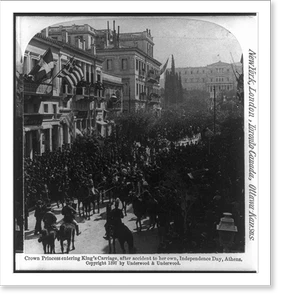
Historic Photo Print - Fourth of July - Crown Princess entering King's
Step back in time with this striking reproduction of Crown Princess entering King's carriage, after accident to her own, Independence Day, Athens. Sourced from the United States Library of Congress...$57.00 -
 Snapshots of the Past
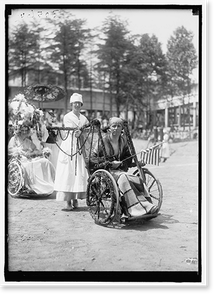
Historic Portrait - Fourth of July - Scenes in Celebration at Walter (2)
Originally preserved in the Library of Congress, this print of FOURTH OF JULY. SCENES IN CELEBRATION AT WALTER REED - 9 is now available for your home or office. The Library has preserved this image...$57.00 -
 Snapshots of the Past
Historic Portrait - Fourth of July - Scenes in Celebration at Walter (1)
Originally preserved in the Library of Congress, this print of FOURTH OF JULY. SCENES IN CELEBRATION AT WALTER REED is now available for your home or office. The Library has preserved this image as...$57.00 -
 Snapshots of the Past
Vintage Portrait - Fourth of July - Tableau on Ellipse
Step back in time with this striking reproduction of FOURTH OF JULY. TABLEAU ON ELLIPSE: 'LIBERTY,' 'COLUMBIA,' AND DANCERS - 2. Sourced from the United States Library of Congress.Library of Congress...$57.00 -
 Snapshots of the Past
Antique Portrait - Fourth of July - Groups on Capitol Steps
Step back in time with this striking reproduction of FOURTH OF JULY. GROUPS ON CAPITOL STEPS. Sourced from the United States Library of Congress.Library of Congress record: Created 1918 Title from...$57.00 -
 Snapshots of the Past
Historic Portrait - Fourth of July - Parades. Float: 'Betsy Ross'
Drawn from the Library of Congress archive, this print depicts FOURTH OF JULY PARADES. FLOAT: 'BETSY ROSS'. The Library holds one of the most comprehensive collections of American and international...$57.00