
Brooklyn Bridge
The Brooklyn Bridge took thirteen years, cost more than fifteen million dollars, killed somewhere between twenty and thirty men, and when it opened in 1883 it was the longest suspension span in the world by half again.
John Roebling designed it and never saw a stone laid. Surveying the Brooklyn tower site in 1869, his foot was crushed by a ferry against a piling. He refused conventional treatment, contracted tetanus and died within weeks.
His son Washington took over and was destroyed by the work in a slower way. The foundations were sunk using caissons \u2014 enormous inverted wooden boxes pumped full of compressed air so men could excavate the riverbed beneath them. Nobody understood decompression sickness. Men came up too fast, doubled over in pain, and a number died. Washington Roebling worked in the caissons himself, was permanently disabled by it, and spent the remaining decade directing construction from a window in Brooklyn Heights with a telescope.
Emily Roebling then ran the project in all but name. She learned the mathematics, the cable specifications and the site management, dealt with the contractors and the trustees, and was for years the only person carrying instructions between her husband and the bridge. When the trustees moved to remove Washington from the post, she argued his case and won. She was the first person to cross the finished bridge, carrying a rooster.
There was also a fraud. A wire contractor supplied defective cable and it was discovered only after some of it was already in place. It could not be removed, so Roebling ordered additional wires added throughout \u2014 which is why the bridge is roughly six times stronger than it needs to be, an accident of dishonesty that has kept it standing for a century and a half.
The photographs of construction are extraordinary because the towers rose alone for years before any deck existed, standing in the East River connected to nothing. The cable spinning that followed, with men working on catwalks hundreds of feet above the water without restraint of any kind, produced images that would not be permitted today.
The promenade above the traffic was Roebling\u2019s idea and is the reason people photograph the bridge the way they do \u2014 the cables converging overhead through the Gothic arches of the towers.
Six days after it opened, someone in the crowd on the promenade shouted that the bridge was collapsing. Twelve people were crushed to death in the panic. P. T. Barnum settled the question the following year by walking twenty-one elephants across it, led by Jumbo, which was both a publicity stunt and a genuinely persuasive engineering demonstration.
The bridge changed the shape of both cities immediately. Brooklyn had been the third largest city in the country in its own right, and the bridge is what made consolidation into Greater New York thinkable in 1898. A great many of the photographs are really about that — two cities becoming one place.
Roebling had a specific reason for the Gothic arches. Suspension bridges of the period had a poor safety record and the public did not trust them, so the towers were built in masonry and detailed as architecture rather than engineering, to reassure people who would otherwise not have walked across.
Where New York Went to Get Away From New York


-

 Snapshots of the Past
Antique Photo Print - New York City - Brooklyn Bridge
Historic Framed Print, Brooklyn Bridge - looking from Brooklyn toward old New York, U.S.A., 17-7/8" x 21-7/8", Image: 16" x 20"Beautiful historic reproduction print from the Library of Congress...$57.00 -
 Snapshots of the Past
Vintage Americana Print - Brooklyn - Bridge - Vintage Home Decor Print
Drawn from the Library of Congress archive, this print depicts Brooklyn Bridge - 5. The Library holds one of the most comprehensive collections of American and international historical prints in the...$57.00 -
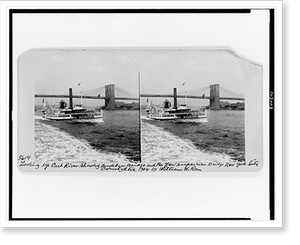 Snapshots of the Past
Historic Landscape - New York City - Looking up East River showing
Originally preserved in the Library of Congress, this print of Looking up East River showing Brooklyn Bridge and the new suspension bridge, New York is now available for your home or office. The...$57.00 -
 Snapshots of the Past
Antique Photo Print - New York City - New York. completing a great work
Originally preserved in the Library of Congress, this print of New York. completing a great work. lashing the stays of the Brooklyn Bridge.from a sketch by a staff artist is now available for your...$57.00 -
 Snapshots of the Past
Vintage Railroad - New York City - New York and Brooklyn Bridge
This rare historical print captures New York and Brooklyn Bridge: Promenade and Manhattan street railroad Terminal in remarkable detail. Sourced directly from the Library of Congress, it represents...$57.00 -
 Snapshots of the Past
Black & White Photo - New York City - Jews - praying on Brooklyn
Originally preserved in the Library of Congress, this print of Jews - New York City - praying on Brooklyn Bridge i.e., Williamsburg Bridge, New Years Day is now available for your home or office. The...$57.00 -
 Snapshots of the Past
Vintage Americana Print - New York City - Brooklyn Bridge and Brooklyn
Historic Framed Print, Brooklyn Bridge and Brooklyn from New York, 17-7/8" x 21-7/8", Image: 16" x 20"Beautiful historic reproduction print from the Library of Congress collections.Created 1...$57.00 -
 Snapshots of the Past
Vintage Building Photo - New York City - Brooklyn Bridge from tower
This rare historical print captures Brooklyn Bridge from tower, New York City in remarkable detail. Sourced directly from the Library of Congress, it represents an authentic piece of documented...$57.00 -
 Snapshots of the Past
Vintage Photo Print - Brooklyn - View looking across the Bridge
Drawn from the Library of Congress archive, this print depicts View looking across the Brooklyn Bridge, N.Y.C. with people walking in both directions. The Library holds one of the most comprehensive...$57.00 -
 Snapshots of the Past
Antique Photo Print - New York City - Manhattan entrance to Brooklyn (2)
This rare historical print captures Manhattan entrance to Brooklyn Bridge, New York - 3 in remarkable detail. Sourced directly from the Library of Congress, it represents an authentic piece of...$57.00 -
 Snapshots of the Past
Historic Maritime - Brooklyn - U.S.S. Iowa passing under Bridge
Originally preserved in the Library of Congress, this print of U.S.S. Iowa passing under Brooklyn Bridge is now available for your home or office. The Library has preserved this image as part of its...$57.00 -
 Snapshots of the Past
Vintage Americana Print - New York City - Brooklyn Bridge and New York
Originally preserved in the Library of Congress, this print of Brooklyn Bridge and New York skyline, New York, N.Y. Classic is now available for your home or office. The Library has preserved this...$57.00