Baseball
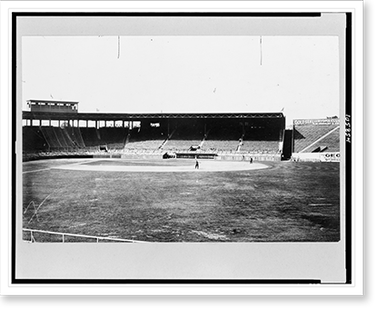
The reason American baseball photography from 1908 to 1920 is as rich as it is comes down to one office. George Grantham Bain ran a news picture agency in New York and covered the local clubs relentlessly, and when his files eventually reached the Library of Congress they brought roughly forty thousand glass negatives with them. The Chicago Daily News did the same thing for the other end of the country.
Those photographers worked from the field. There was no restriction keeping them in a press box, so they stood along the foul lines and behind the plate with tripods and set up portraits against the outfield wall. That is why the players look at you. A modern sports photograph is taken from distance with a long lens; these were taken from a few feet away by a man the player knew by name.
The game itself was a different sport. The deadball era ran to about 1920 and the ball was used until it fell apart — discolored, softened, scuffed and often deliberately loaded with tobacco juice or scarred with a file. Home runs were rare, runs were manufactured a base at a time with bunts and steals, and a team could lead the league with fewer than thirty home runs all season.
The parks were wooden and they burned. Almost every nineteenth-century ballpark caught fire at least once, and the Polo Grounds burned in 1911 and was rebuilt in concrete while the season was underway. That fire risk drove the rebuilding wave that produced the parks people still know. Shibe Park in Philadelphia came first in 1909, then Forbes Field, Comiskey, and in 1912 alone Fenway, Ebbets Field and Navin Field in Detroit. Wrigley followed in 1914. Photographs from before 1909 and after 1915 are of two different worlds.
The Negro Leagues belong in this category and the record is thinner, for a reason worth stating. Rube Foster organized the Negro National League in Kansas City in 1920, and the teams drew large crowds and played a faster, more aggressive game than the white majors. But the mainstream press did not cover them, so almost everything that survives came through Black newspapers and independent photographers. There is far less of it, and what exists is correspondingly valuable.
Women played too, and the photographs are easy to miss because the teams were marketed as novelties. Bloomer girls clubs barnstormed from the 1890s into the 1930s, playing men’s semipro teams for money, and some of them were genuinely good.
Ballpark advertising is the other thing worth looking at. Outfield walls were sold foot by foot to local businesses, and the painted signs — for cigars, clothiers, whiskey and patent tonics — are a directory of what a city bought in a given year. A few offered prizes to any player who hit the sign, which is why the ads are placed where a ball might actually reach.
One caution on captions. Team and player identifications on early news negatives were written on envelopes by clerks working fast, and they are wrong often enough to matter. Uniform lettering and ballpark features are more reliable than the handwriting.
The Roads Came After the Cars



-

 Snapshots of the Past
Historic Framed Print Scene during second game of 1944 world series, 17-7/8" x 21-7/8"
Scene during second game of 1944 world series, 17-7/8" x 21-7/8" , Image: 16" x 20"Note: Some images may show issues such as color bars or other artifacts from the digital scanning process at the...$57.00 -
 Snapshots of the Past
Historic Framed Print Vintage Baseball Print - 21, 17-7/8" x 21-7/8"
Vintage Baseball Print - 21, 17-7/8" x 21-7/8" , Image: 16" x 20"Note: Some images may show issues such as color bars or other artifacts from the digital scanning process at the Library. We clean up...$57.00 -
 Snapshots of the Past
Historic Framed Print Vintage Baseball Print - 20, 17-7/8" x 21-7/8"
Vintage Baseball Print - 20, 17-7/8" x 21-7/8" , Image: 16" x 20"Note: Some images may show issues such as color bars or other artifacts from the digital scanning process at the Library. We clean up...$57.00 -
 Snapshots of the Past
Historic Framed Print Vintage Baseball Print - 19, 17-7/8" x 21-7/8"
Vintage Baseball Print - 19, 17-7/8" x 21-7/8" , Image: 16" x 20"Note: Some images may show issues such as color bars or other artifacts from the digital scanning process at the Library. We clean up...$57.00 -
 Snapshots of the Past
Historic Framed Print Vintage Baseball Print - 18, 17-7/8" x 21-7/8"
Vintage Baseball Print - 18, 17-7/8" x 21-7/8" , Image: 16" x 20"Note: Some images may show issues such as color bars or other artifacts from the digital scanning process at the Library. We clean up...$57.00 -
 Snapshots of the Past
Historic Framed Print Vintage Baseball Print - 17, 17-7/8" x 21-7/8"
Vintage Baseball Print - 17, 17-7/8" x 21-7/8" , Image: 16" x 20"Note: Some images may show issues such as color bars or other artifacts from the digital scanning process at the Library. We clean up...$57.00 -
 Snapshots of the Past
Historic Framed Print Vintage Baseball Print - 16, 17-7/8" x 21-7/8"
Vintage Baseball Print - 16, 17-7/8" x 21-7/8" , Image: 16" x 20"Note: Some images may show issues such as color bars or other artifacts from the digital scanning process at the Library. We clean up...$57.00 -
 Snapshots of the Past
Historic Framed Print Vintage Baseball Print - 15, 17-7/8" x 21-7/8"
Vintage Baseball Print - 15, 17-7/8" x 21-7/8" , Image: 16" x 20"Note: Some images may show issues such as color bars or other artifacts from the digital scanning process at the Library. We clean up...$57.00 -
 Snapshots of the Past
Historic Framed Print Vintage Baseball Print - 14, 17-7/8" x 21-7/8"
Vintage Baseball Print - 14, 17-7/8" x 21-7/8" , Image: 16" x 20"Note: Some images may show issues such as color bars or other artifacts from the digital scanning process at the Library. We clean up...$57.00 -
 Snapshots of the Past
Historic Framed Print Vintage Baseball Print - 13, 17-7/8" x 21-7/8"
Vintage Baseball Print - 13, 17-7/8" x 21-7/8" , Image: 16" x 20"Note: Some images may show issues such as color bars or other artifacts from the digital scanning process at the Library. We clean up...$57.00 -
 Snapshots of the Past
Historic Framed Print Vintage Baseball Print - 12, 17-7/8" x 21-7/8"
Vintage Baseball Print - 12, 17-7/8" x 21-7/8" , Image: 16" x 20"Note: Some images may show issues such as color bars or other artifacts from the digital scanning process at the Library. We clean up...$57.00 -
 Snapshots of the Past
Historic Framed Print Vintage Baseball Print - 11, 17-7/8" x 21-7/8"
Vintage Baseball Print - 11, 17-7/8" x 21-7/8" , Image: 16" x 20"Note: Some images may show issues such as color bars or other artifacts from the digital scanning process at the Library. We clean up...$57.00