Patriotic
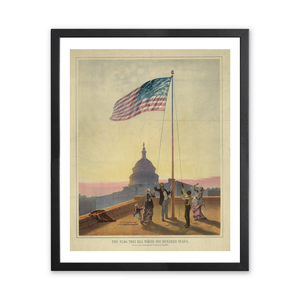
There was no official arrangement of the stars on the American flag until June 1912. Congress had specified the number of stars and stripes and said nothing about the layout, so for a hundred and thirty-five years flag makers did as they pleased.
That is why nineteenth-century photographs show flags with the stars in circles, in ovals, in a diamond, scattered at random, or arranged into one large star made of smaller ones — the Great Star pattern. Thirty-eight star flags from 1877 exist in a dozen different configurations. An unfamiliar star field in an old photograph is not a fake and not a foreign flag. It is a flag made before William Howard Taft signed the executive order that fixed the rows.
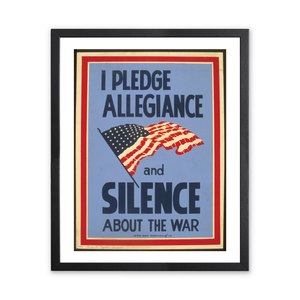
The Pledge of Allegiance is also datable and its origin is commercial. It was written in 1892 by Francis Bellamy for the Youth’s Companion, a magazine that was running a campaign to put a flag in every school in the country and selling those flags by subscription. The pledge was published for the four hundredth anniversary of Columbus’s landing and adopted by schools nationwide. The original accompanying gesture, the Bellamy salute, was an extended right arm, which for obvious reasons was replaced with a hand over the heart by act of Congress in December 1942.
The First World War produced the densest patriotic imagery in the archive, and most of it was made to raise money. Liberty Loan drives ran four times plus a Victory Loan, and each one came with parades, rallies, captured German artillery hauled through main streets, film stars speaking from courthouse steps, and enormous quantities of poster art. Food conservation campaigns produced their own body of images. So did the Red Cross, the YMCA and the Salvation Army canteens.
The most remarkable objects in this whole category are the living photographs. Arthur Mole and John Thomas arranged troops and workers at military camps into vast formations — a flag, an eagle, the Liberty Bell, a portrait of Woodrow Wilson, the Statue of Liberty — and photographed them from an eighty-foot tower with a wide-angle camera. The human Liberty Bell used about twenty-five thousand officers and men. Perspective did the work: the figures nearest the camera were spread thin and those at the far end packed tight, so the shape reads correctly only from the one point where the lens was.
The everyday material matters as much. Bunting on storefronts for a centennial. Memorial Day at a small-town cemetery with veterans arranged by war, the Civil War men getting older in each successive photograph. Flag-raisings at schools. Fraternal and veterans’ organizations in full regalia.
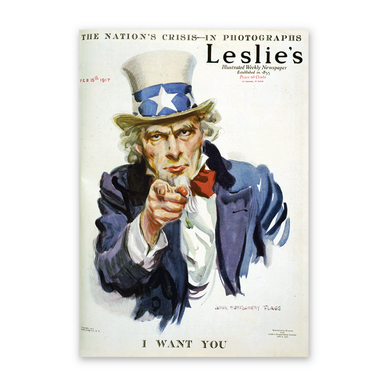
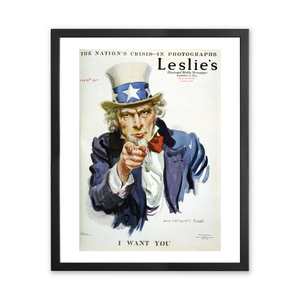
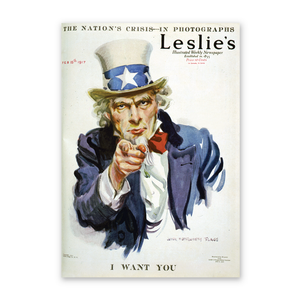
The eagle carries almost as much of this imagery as the flag does. It appears on shop signs, fire equipment, fraternal regalia, courthouse pediments, weather vanes and the back of every coin, and photographers framed buildings to include it. Uncle Sam is later than people assume as a face — the figure is old, but the recruiting poster look was fixed by James Montgomery Flagg in 1917.
Two notes for captions. Flags with forty-five stars date between 1896 and 1908, forty-six between 1908 and 1912, forty-eight from 1912 to 1959 — counting the stars is often the fastest date on an image with no other markings. And Flag Day, observed since the 1880s and proclaimed by Wilson in 1916, was not established by law until 1949.
The Railroads Invented What Time It Is


-

 Snapshots of the Past
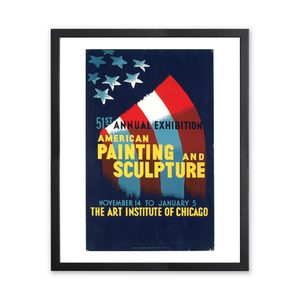
Historic Framed Print Vintage Patrioit Print - 3, 17-7/8" x 21-7/8"
Vintage Patrioit Print - 3, 17-7/8" x 21-7/8" , Image: 16" x 20"Note: Some images may show issues such as color bars or other artifacts from the digital scanning process at the Library. We clean up...$57.00 -
 Snapshots of the Past
Historic Framed Print Don't Touch My Flag!, 17-7/8" x 21-7/8"
Don't Touch My Flag!, 17-7/8" x 21-7/8" , Image: 16" x 20"Note: Some images may show issues such as color bars or other artifacts from the digital scanning process at the Library. We clean up these...$57.00 -
 Snapshots of the Past
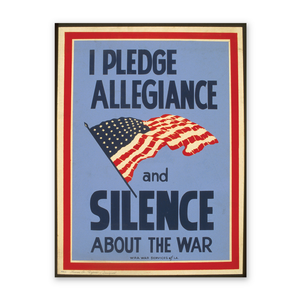
Historic Framed Print Vintage Patrioit Print - 2, 17-7/8" x 21-7/8"
Vintage Patrioitic Print - 2, 17-7/8" x 21-7/8" , Image: 16" x 20"Note: Some images may show issues such as color bars or other artifacts from the digital scanning process at the Library. We clean...$57.00 -
 Snapshots of the Past
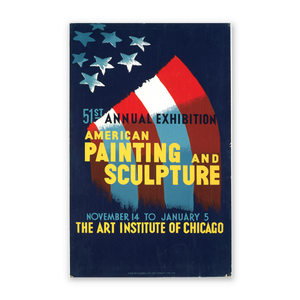
Historic Framed Print Vintage Patrioit Print - 1, 17-7/8" x 21-7/8"
Vintage Patrioitic Print - 1, 17-7/8" x 21-7/8" , Image: 16" x 20"Note: Some images may show issues such as color bars or other artifacts from the digital scanning process at the Library. We clean...$57.00 -
 Snapshots of the Past
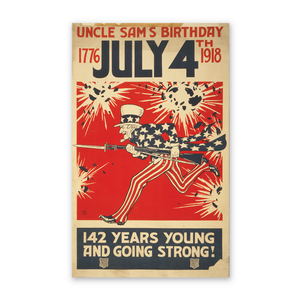
Vintage Photo Print - Uncle Sam's birthday July 4th 142 years, 1776
This rare historical print captures Uncle Sam's birthday July 4th 1776-1918 142 years young and going strong! in remarkable detail. Sourced directly from the Library of Congress, it represents an...$57.00 -
 Snapshots of the Past
Historic Photo Print - I want you.James Montgomery Flagg
Historic Framed Print, I want you.James Montgomery Flagg. - 2, 17-7/8" x 21-7/8", Image: 16" x 20"Beautiful historic reproduction print from the Library of Congress collections.Created 1917 Illus...$57.00