Jacksonville
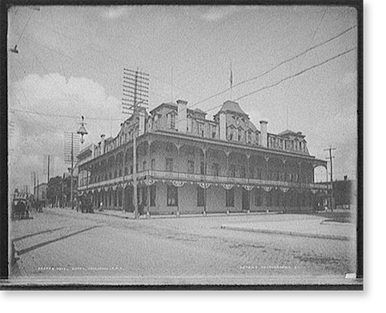
Jacksonville sits on a bend in the St. Johns, one of the few rivers in North America that flows north, and the city was for a period the winter destination of the American northeast.
The tourist trade began after the Civil War and ran until Henry Flagler\u2019s railway pushed further south in the 1890s and took the money to St. Augustine, Palm Beach and eventually Miami. For that quarter-century Jacksonville had grand riverfront hotels, steamboat excursions up the St. Johns, and a winter season of northerners escaping the cold. The photographs of those hotels and the boats are the record of a resort era most people have forgotten happened there.
The fire of May 1901 is the central event. It started in a fiber factory when sparks landed on drying moss, and within eight hours it had destroyed one hundred and forty-six city blocks, more than two thousand buildings, and left roughly ten thousand people homeless. It is still one of the worst urban fires in American history, and the glow was reported visible in Savannah.
What followed is why the city looks the way it does. Henry Klutho, a New York architect, arrived to take part in the rebuilding and brought Prairie School ideas with him, so downtown Jacksonville has a concentration of early modern commercial architecture unusual for the South.
The film industry is the surprise in this material. Between roughly 1908 and 1922, Jacksonville was a major center of American movie production \u2014 over thirty studios, drawn by sunshine, cheap labor and varied scenery, at a time when Hollywood was not yet dominant. It ended when a reform mayor was elected on a platform of getting rid of the film people, who were regarded as disreputable and who kept staging fake bank robberies and car chases in the streets.
The other constant is the port and the naval presence, which grew steadily and dominates the later photographs.
For dating, the fire is the hinge. Anything wooden and pre-modern is before May 1901; the brick and steel downtown is after.
The winter tourists left a specific photographic legacy. Studios along Bay Street sold views of the river, the hotels and the orange groves to visitors as souvenirs, so a great deal of what survives from the 1880s and 1890s was made to be taken home to Ohio and put in an album.
LaVilla, west of downtown, is the counterpart to the tourist city. A Black community incorporated separately before being annexed, with its own commercial district, theaters on the Chitlin’ Circuit and a musical tradition that produced James Weldon Johnson, who wrote Lift Every Voice and Sing with his brother in Jacksonville in 1900.
The Mayport and Pablo Beach traffic is a smaller subject worth knowing. A narrow-gauge railway ran east to the ocean beaches from the 1880s, carrying day trippers, and the pavilions and boardwalks it served are their own body of photographs.
The bridges are the modern landmark. Until 1921 there was no road crossing of the St. Johns at all, and everything moved by ferry. The Acosta Bridge changed the shape of the city, and later spans made the river skyline that appears in every twentieth-century photograph.
Three Rivers and the Furnaces Between Them





-

 Snapshots of the Past
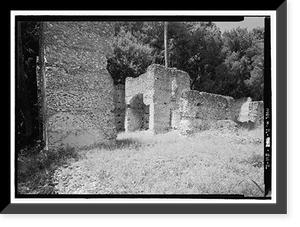
Vintage Building Photo - Jacksonville, Florida - Thomson Tabby House (2)
Drawn from the Library of Congress archive, this print depicts Thomson Tabby House, Fort George Road, Jacksonville, Duval County, FL - 3 Classic. The Library holds one of the most comprehensive...$57.00 -
 Snapshots of the Past
Vintage Building Photo - Jacksonville, Florida - Thomson Tabby House (1)
Step back in time with this striking reproduction of Thomson Tabby House, Fort George Road, Jacksonville, Duval County, FL - 2. Sourced from the United States Library of Congress.Library of Congress...$57.00 -
 Snapshots of the Past
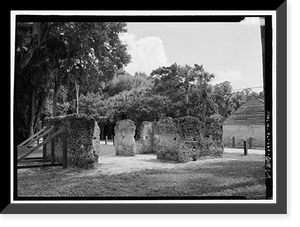
Vintage Building Photo - Jacksonville, Florida - Kingsley Plantation (1)
Step back in time with this striking reproduction of Kingsley Plantation, House, 11676 Palmetto Avenue, Jacksonville, Duval County, FL - 2. Sourced from the United States Library of Congress.Library...$57.00 -
 Snapshots of the Past
Vintage Building Photo - Jacksonville, Florida - Kingsley Plantation (2)
Step back in time with this striking reproduction of Kingsley Plantation, Slave Quarters, 11676 Palmetto Avenue, Jacksonville, Duval County, FL - 3. Sourced from the United States Library of Congress...$57.00 -
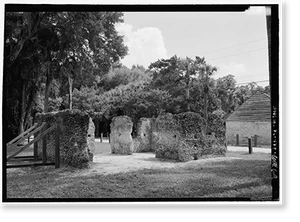 Snapshots of the Past
Antique Architecture - Jacksonville, Florida - Kingsley Plantation (2)
This rare historical print captures Kingsley Plantation, 11676 Palmetto Avenue, Jacksonville, Duval County, FL - 64 in remarkable detail. Sourced directly from the Library of Congress, it represents...$57.00 -
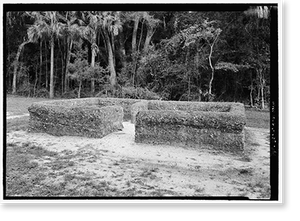 Snapshots of the Past
Antique Architecture - Jacksonville, Florida - Kingsley Plantation (1)
Step back in time with this striking reproduction of Kingsley Plantation, 11676 Palmetto Avenue, Jacksonville, Duval County, FL - 41. Sourced from the United States Library of Congress.Library of...$57.00 -
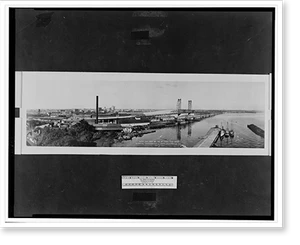 Snapshots of the Past
Vintage Panoramic - Jacksonville - Bird's eye view of the St, 1921
Step back in time with this striking reproduction of Bird's eye view of the St. Johns River Bridge connecting Jacksonville and South Jacksonville, Fla., June 27, 1921. Sourced from the United States...$57.00 -
 Snapshots of the Past
Vintage Photo Print - Jacksonville, Florida - Water front #1
Drawn from the Library of Congress archive, this print depicts Water front #1, Jacksonville, Fla. The Library holds one of the most comprehensive collections of American and international historical...$57.00 -
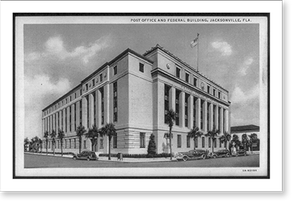 Snapshots of the Past
Vintage Building Photo - Jacksonville, Florida - Post Office
Originally preserved in the Library of Congress, this print of Post Office and Federal Building, Jacksonville, Fla is now available for your home or office. The Library has preserved this image as...$57.00 -
 Snapshots of the Past
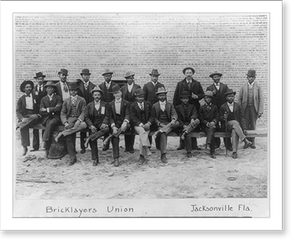
Historic Portrait - Jacksonville - Portrait group of African American (2)
Originally preserved in the Library of Congress, this print of Portrait group of African American Bricklayers union, Jacksonville, Florida is now available for your home or office. The Library has...$57.00 -
 Snapshots of the Past
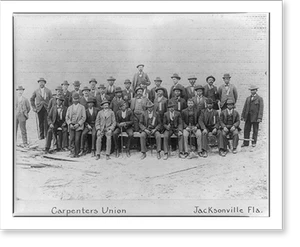
Historic Portrait - Jacksonville - Portrait group of African American (1)
Step back in time with this striking reproduction of Portrait group of African American Carpenters union, Jacksonville, Florida. Sourced from the United States Library of Congress.Library of Congress...$57.00 -
 Snapshots of the Past
Vintage Photo Print - Jacksonville - The St. John's
This rare historical print captures The St. John's at Jacksonville in remarkable detail. Sourced directly from the Library of Congress, it represents an authentic piece of documented history.Library...$57.00