
Baltimore
On 7 February 1904 a fire started in a downtown warehouse and burned for thirty hours, taking about fifteen hundred buildings across seventy blocks. Fire companies came from Washington, Philadelphia and New York and found their hose couplings did not fit Baltimore's hydrants — which is the reason the United States has standardized fire hydrant fittings today.
Nobody died. The district was rebuilt within two years, and the photographs of the ruins and of the rebuilding are the most complete record of any American urban fire of the period.
Fort McHenry guards the harbor entrance and is where Francis Scott Key watched the British bombardment through the night of 13 September 1814 and wrote the verses that became the national anthem. The flag he saw was thirty by forty-two feet, deliberately oversized. Photographs of the fort from this period show it in use as an army post rather than a monument.
The Baltimore and Ohio was the first common-carrier railroad in the United States, chartered in 1827, and the city has never stopped being a railroad town. The Mount Clare shops, the roundhouse, the Thomas Viaduct of 1835 — all of it appears in the archive, and the B and O ran its own photographic department.
Baltimore is a row-house city and the white marble steps are its signature. They were scrubbed weekly, by hand, and photographs of women doing it were a genre in themselves. The stone came from quarries just north of the city.
The harbor was working throughout — oyster boats, the skipjacks that dredged under sail because Maryland law required it, canneries, and the immigration pier at Locust Point, which was the second largest entry point in the country after Ellis Island.
Around five hundred and ninety images name Baltimore.
The Canal Terminus That Powered Itself With a Waterfall






-

 Snapshots of the Past
Historic Maritime - Baltimore - U.S.S. Admiral Watson, 1900
Originally preserved in the Library of Congress, this print of U.S.S. Baltimore, Admiral Watson, 1900 is now available for your home or office. The Library has preserved this image as part of its...$57.00 -
 Snapshots of the Past
Historic Maritime - Baltimore - U.S.S. ship's company
Originally preserved in the Library of Congress, this print of U.S.S. Baltimore, ship's company is now available for your home or office. The Library has preserved this image as part of its permanent...$57.00 -
 Snapshots of the Past
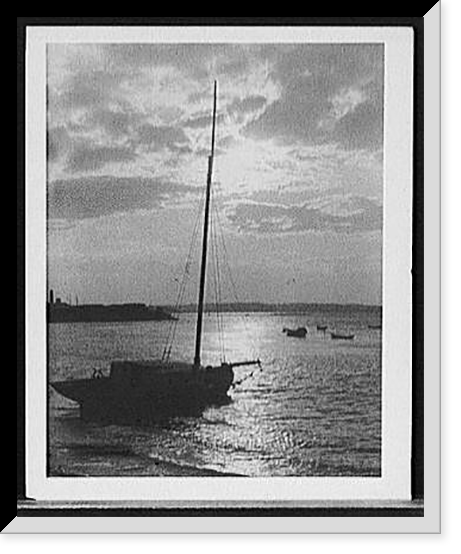
Vintage Military Print - Baltimore, Maryland - Sunset off Fort McHenry
This rare historical print captures Sunset off Fort McHenry, Baltimore, Md. Classic in remarkable detail. Sourced directly from the Library of Congress, it represents an authentic piece of documented...$57.00 -
 Snapshots of the Past
Antique Scenic Print - Baltimore, Maryland - Bactrian camels
This rare historical print captures Bactrian camels, Druid Hill Park, Baltimore, Md in remarkable detail. Sourced directly from the Library of Congress, it represents an authentic piece of documented...$57.00 -
 Snapshots of the Past
Vintage Landscape - Baltimore, Maryland - Bactrian camel
This rare historical print captures Bactrian camel, Druid Hill Park, Baltimore, Md in remarkable detail. Sourced directly from the Library of Congress, it represents an authentic piece of documented...$57.00 -
 Snapshots of the Past
Historic Architecture - Baltimore, Maryland - Hotel Kernan & Theatre (1)
Step back in time with this striking reproduction of Hotel Kernan & Maryland Theatre, Baltimore, Md. Sourced from the United States Library of Congress.Library of Congress record: Created c1906 G...$57.00 -
 Snapshots of the Past
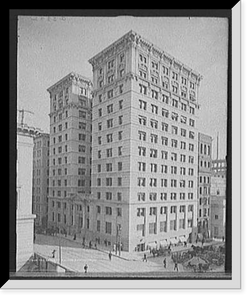
Antique Architecture - Baltimore, Maryland - The Calvert Building
Originally preserved in the Library of Congress, this print of The Calvert Building, Baltimore, Md is now available for your home or office. The Library has preserved this image as part of its...$57.00 -
 Snapshots of the Past
Historic Architecture - Baltimore, Maryland - B. & O. R.R. and Ohio
This rare historical print captures B. & O. R.R. i.e. Baltimore and Ohio Railroad Co. office building, Baltimore, Md in remarkable detail. Sourced directly from the Library of Congress, it represents...$57.00 -
 Snapshots of the Past
Vintage Americana Print - Baltimore, Maryland - Light St., looking north
Originally preserved in the Library of Congress, this print of Light St., looking north, Baltimore, Md is now available for your home or office. The Library has preserved this image as part of its...$57.00 -
 Snapshots of the Past
Antique Photo Print - Baltimore, Maryland - Unloading oyster luggers
This rare historical print captures Unloading oyster luggers, Baltimore, Md in remarkable detail. Sourced directly from the Library of Congress, it represents an authentic piece of documented history...$57.00 -
 Snapshots of the Past
Historic Photo Print - Baltimore, Maryland - Pay day for the stevedores
Originally preserved in the Library of Congress, this print of Pay day for the stevedores, Baltimore, Md. - 2 is now available for your home or office. The Library has preserved this image as part of...$57.00 -
 Snapshots of the Past
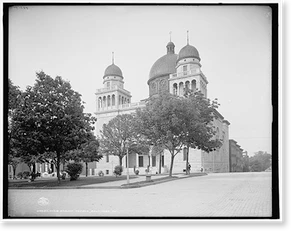
Vintage Photo Print - Baltimore, Maryland - Oheb Shalom Temple
Drawn from the Library of Congress archive, this print depicts Oheb Shalom Temple, Baltimore, Md. The Library holds one of the most comprehensive collections of American and international historical...$57.00