Central Park
Almost nothing in Central Park is natural. It is a manufactured landscape on ground that was swamp, rock outcrop and pig farm, and building it took fifteen years and more gunpowder than was fired at Gettysburg.
Frederick Law Olmsted and Calvert Vaux won the design competition in 1858 with a plan called Greensward, and its central idea was concealment. The four transverse roads carrying crosstown traffic are sunk below grade so a person in the park never sees them. The paths for carriages, riders and walkers are separated and cross by bridge so they never meet. Every one of the thirty-six bridges is a different design.
Five million cubic yards of material were moved. Half a million trees and shrubs were planted. The lake, the ramble, the meadows and the hills were all placed deliberately to produce a sequence of views, and the effect intended was that a visitor should feel they had left the city rather than entered a garden.
There was a community on the land and it was removed. Seneca Village, on the west side around what is now Eighty-fifth Street, was a settlement of roughly two hundred and sixty people, mostly African American, with three churches, a school and a cemetery. It was the largest concentration of Black property owners in the city. The residents were evicted under eminent domain in 1857 and the village was erased so completely that it was rediscovered by archaeologists only in the 1990s.
The early photographs show a park that looks bare, because the planting had not grown in. Pictures from the 1860s and 1870s show open ground, young trees and long views that no longer exist. That is the park as designed rather than as matured.
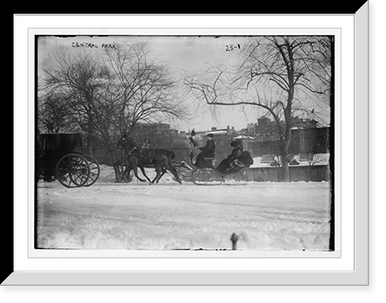
Carriage driving is the dominant activity in nineteenth-century images. The park was laid out for it, and being seen driving on the East Drive in the afternoon was a social obligation for anyone who could afford a rig.
For dating, the vehicles and the trees do the work together. Bare ground with saplings is 1860s. Carriages give way to automobiles in the 1910s, and by then the canopy has closed.
The sheep were real. A flock grazed the Sheep Meadow from the 1860s until 1934, tended by a shepherd who moved them across the West Drive twice a day and housed them in a building that is now the Tavern on the Green. They were removed during the Depression, reportedly out of concern that they would be eaten.
Winter photographs are among the best of the early material. Skating on the lake was an enormous public activity from the 1860s, with a ball raised on a pole to signal that the ice was safe, and crowds of many thousands on the ice at once. It was one of the few public amusements where men and women mixed freely, which is part of why it was so popular.
Olmsted invented a profession while building it. There was no such thing as a landscape architect in America before this project, and the terms he set — that a public park was a democratic institution, that it should serve people who had no country house, that it should be designed as a single work — shaped every city park built in America afterward.
The Lake That Two Wars Were Fought Over


-

 Snapshots of the Past
Historic Landscape - New York City - An Afternoon procession
This rare historical print captures An Afternoon procession on the driveway, Central Park, New York in remarkable detail. Sourced directly from the Library of Congress, it represents an authentic...$57.00 -
 Snapshots of the Past
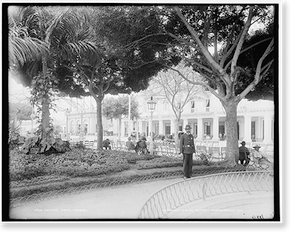
Vintage Landscape - Central Park - Havana - Vintage Home Decor Print
Originally preserved in the Library of Congress, this print of Central park, Havana Classic is now available for your home or office. The Library has preserved this image as part of its permanent...$57.00 -
 Snapshots of the Past
Historic Landscape - Central Park - Shooting Bull - Vintage Wall Art Gift
This rare historical print captures Shooting Bull . Central Park - 3 in remarkable detail. Sourced directly from the Library of Congress, it represents an authentic piece of documented history...$57.00 -
 Snapshots of the Past
Historic Landscape - Central Park - Trench in - Antique Wall Decor Print
This rare historical print captures Trench in Central Park in remarkable detail. Sourced directly from the Library of Congress, it represents an authentic piece of documented history.Library of...$57.00 -
 Snapshots of the Past
Historic Landscape - Louisville, Kentucky - Central Park
Step back in time with this striking reproduction of Admiral Corsi. Sourced from the United States Library of Congress.Library of Congress record: Title from unverified data provided by the Bain News...$57.00 -
 Snapshots of the Past
Vintage Landscape - Louisville, Kentucky - Colonnade, Central Park
Step back in time with this striking reproduction of Princess Tsianina Redfeather. Sourced from the United States Library of Congress.Library of Congress record: Title from unverified data provided...$57.00 -
 Snapshots of the Past
Historic Architecture - New York City - The Plaza Hotel and Central
Drawn from the Library of Congress archive, this print depicts Coach Daly & Capt. Weyand, West Point. The Library holds one of the most comprehensive collections of American and international...$57.00 -
 Snapshots of the Past
Antique Scenic Print - New York City - Horse drawn sleigh in Central
Drawn from the Library of Congress archive, this print depicts Horse drawn sleigh in Central Park, New York City. The Library holds one of the most comprehensive collections of American and...$57.00 -
 Snapshots of the Past
Vintage Landscape - New York City - Horse drawn carriages in Central
Drawn from the Library of Congress archive, this print depicts Horse drawn carriages in Central Park, New York City Classic. The Library holds one of the most comprehensive collections of American...$57.00