
Coney Island
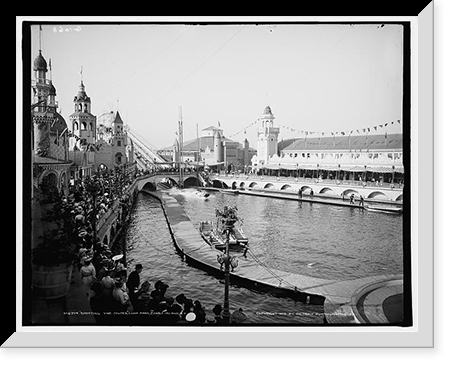
Coney Island in the archive is a specific twenty-five years, roughly 1897 to 1920s, and the thing that made it photographable was electricity.
Three enclosed amusement parks ran at once and they were not alike. Steeplechase opened in 1897 around a mechanical horse race on rails that carried riders around the outside of the building. Luna Park opened in 1903 with towers and minarets covered in something like a quarter of a million incandescent bulbs, bright enough to be a navigational reference for ships offshore. Dreamland opened in 1904 and tried to be the respectable one — white instead of gaudy, a million bulbs, higher-minded attractions, and it never made money.
Night photographs of Luna Park are among the earliest widely circulated pictures of electric light used purely as spectacle. Most Americans in 1905 did not have electricity at home. They came to Brooklyn and saw a skyline of it.
Before the parks there were the hotels, and one of them was shaped like an elephant. The Elephant Hotel stood a hundred and twenty feet tall from 1885 until it burned in 1896, with rooms in the legs and a cigar shop in one front thigh. It was visible from ships before the Statue of Liberty was, and “seeing the elephant” entered the language.
The crowd changed in 1920, when the subway reached Coney Island and the fare was a nickel. What had been a resort for people who could afford a train excursion became a beach that any New Yorker could reach for five cents, and the photographs from the 1920s and 1930s show the packed sand that Coney is now remembered for — hundreds of thousands of people on a hot Sunday.
Two rides from that period are still standing. The Wonder Wheel went up in 1920 with cars that slide on interior tracks as the wheel turns. The Cyclone opened in 1927 on the site of an earlier coaster and is still operating.
The strangest attraction was medical. Martin Couney ran an infant incubator exhibit on the midway for decades, charging admission to see premature babies in early incubators. Hospitals of the period largely would not treat such infants and the equipment was expensive, so Couney funded the care with ticket sales and took no money from the parents. By his own count he saved something close to sixty-five hundred children. The sideshow was the neonatal ward.
The Boardwalk Was Built to Keep Sand Out of Lobbies


-

 Snapshots of the Past
Antique Scenic Print - Coney Island - Shooting the chutes, Luna Park
This rare historical print captures Shooting the chutes, Luna Park, Coney Island, N.Y in remarkable detail. Sourced directly from the Library of Congress, it represents an authentic piece of...$57.00 -
 Snapshots of the Past
Historic Landscape - Coney Island - South end of Bowery, N.Y
Step back in time with this striking reproduction of South end of Bowery, Coney Island, N.Y. Sourced from the United States Library of Congress.Library of Congress record: Created c1903 Steeplechase...$57.00 -
 Snapshots of the Past
Vintage Landscape - Coney Island - On the beach
This rare historical print captures On the beach at Coney Island - 2 Classic in remarkable detail. Sourced directly from the Library of Congress, it represents an authentic piece of documented...$57.00 -
 Snapshots of the Past
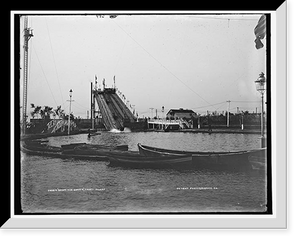
Vintage Landscape - Coney Island - Shoot the Shoots Chutes (2)
Originally preserved in the Library of Congress, this print of Shoot the Shoots i.e. Chutes, Coney Island - 2 is now available for your home or office. The Library has preserved this image as part of...$57.00 -
 Snapshots of the Past
Vintage Landscape - Coney Island - Shoot the Shoots Chutes (1)
Drawn from the Library of Congress archive, this print depicts Shoot the Shoots i.e. Chutes, Coney Island. The Library holds one of the most comprehensive collections of American and international...$57.00