
Courthouses
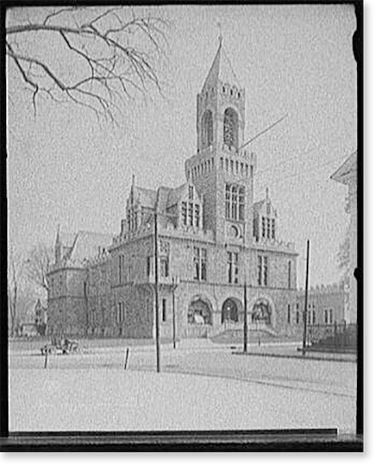
A county courthouse is the only building most American towns ever put real money into, and the photographs show a hundred years of communities trying to out-build the county next door.
The form is remarkably consistent across the country. A square block, a lawn, a building set in the middle rather than on the street line, a dome or a clock tower, and a flight of steps that matters more than it needs to. That arrangement came from the Northwest Ordinance survey and spread with settlement, which is why a courthouse square in Ohio and one in Texas are recognizably the same idea.
The architecture moves in visible waves. Greek Revival in the 1840s and 1850s, all columns and pediments, because a young republic wanted to look like a classical one. Then Italianate. Then the heavy Romanesque of the 1880s and 1890s, with rusticated stone and round arches and a tower, which is the style people picture when they picture a courthouse. Then Beaux-Arts, then a plainer classicism between the wars.
The competition was real and occasionally ruinous. Counties borrowed heavily, hired architects who worked the circuit building the same design in a dozen places with minor variations, and put up buildings well beyond what the local population required. A number of counties were still paying for their courthouse when the next one burned down.
The interiors are photographed less often and are worth finding. A nineteenth-century courtroom is a theater — raised bench, rail, jury box along one wall, spectator seating and often a gallery, all in oiled woodwork with a pressed tin ceiling above. The room was built to be watched from, because a trial was public entertainment in a county with little else on offer.
The square itself is the other subject. Photographs taken from an upper courthouse window looking down are among the best records of small-town commerce that exist — the storefronts, the hitching rails, the awnings, the wagons, and later the angled parking. The building was usually the tallest thing for miles, which made it the natural place to photograph a town from.
The monuments on the lawn carry their own history and it is not comfortable. Civil War memorials went up in waves from the 1880s through the 1920s, and in the South a great many of them were erected decades after the war during periods of racial repression rather than in immediate mourning. A courthouse photograph that includes the lawn is documenting that too.
Fire is the reason so many counties are on their third or fourth building. Courthouses burned constantly — wood frame construction, wood stoves, oil lamps and a basement full of paper — and the loss of the records was usually worse than the loss of the building. Genealogists still speak of burned counties, meaning places where the deeds and marriages went up with the roof.
For dating a photograph, the wires help. Telegraph and then telephone lines appear around the square through the 1880s and 1890s, electric streetlights follow, and paving arrives last. A courthouse square with dirt streets and no poles is early.
The Engine as Portrait Subject

-

 Snapshots of the Past
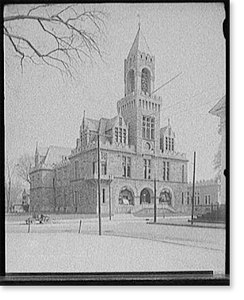
Vintage Building Photo - Springfield, Massachusetts - Court House
Originally preserved in the Library of Congress, this print of Duke Connaught at Ruins, Ottawa is now available for your home or office. The Library has preserved this image as part of its permanent...$57.00