
Historic American Buildings Survey

The Historic American Buildings Survey began in 1933 as a make-work program for unemployed architects, and it turned into the most systematic architectural record any country has ever made of itself.
The idea came from Charles Peterson, a young National Park Service architect who proposed putting a thousand out-of-work draftsmen to the task of documenting American buildings before they disappeared. The Depression had put architects out of work and had also, by stopping construction, made it a good moment to look at what already stood. The program was approved in weeks.
The method is what makes the material valuable. A HABS record is not a snapshot. It is a set of measured drawings made to archival standards, large-format photographs shot with a view camera on a tripod, and written historical documentation — all three, filed together, for a single building. The photographs are deliberately plain: straight-on, evenly lit, no atmosphere, because the purpose was record rather than art.
That plainness is the point. A HABS photograph of a doorway shows you the doorway. Every molding profile, every hinge, every course of brick. If the building burned the following year, and many did, the record is complete enough to rebuild from.
The photographers worked under an unusual instruction: record, do not interpret. No dramatic angles, no atmospheric light, nothing that would flatter the building or the picture. That discipline is why the results are still usable ninety years later, when a more artful survey would look dated.
The range is enormous and it is not confined to grand houses. Mills, barns, slave quarters, privies, lighthouses, covered bridges, storefronts, courthouses, tenements, sawmills and outbuildings all got the same treatment as the mansions. That was a deliberate decision and an unusual one for its time — the survey took the position that ordinary buildings were also history.
The drawings deserve as much attention as the photographs and get far less. A HABS sheet is drawn in ink on archival linen or mylar to a standard that has not changed in ninety years — plans, elevations, sections and details, at stated scale, with a title block. They were made by hand by draftsmen who had trained as architects, and a good sheet is a beautiful object in its own right.
The photographers were professionals hired for the work, and the best of them are worth knowing by name. Their negatives run to eight by ten inches, which is why a HABS image holds detail at any enlargement.
The survey never stopped. It has run continuously since 1933 apart from a wartime pause, and the collection now covers tens of thousands of structures. A great many of them no longer exist, which was always the expectation.
The Historic American Engineering Record was added in 1969 and works the same way for bridges, dams, factories, canals and machinery. The two collections sit together and it is worth searching both — a great deal of industrial America was documented under the engineering record rather than the buildings survey.
For captions, the HABS naming convention gives you the building, the street address, the city, the county and the state, in that order. It is verbose but it is precise, and it means you can find the site on a map.
The Photographers Who Followed the Armies




-

 Snapshots of the Past
Vintage Building Photo - Lompoc vicinity, California - Point Arguello (3)
Drawn from the Library of Congress archive, this print depicts Point Arguello Coast Guard Rescue Station, Lompoc vicinity, Santa Barbara County, CA - 16. The Library holds one of the most...$57.00 -
 Snapshots of the Past
Vintage Building Photo - Lompoc vicinity, California - Point Arguello (2)
This rare historical print captures Point Arguello Coast Guard Rescue Station, Lompoc vicinity, Santa Barbara County, CA - 8 in remarkable detail. Sourced directly from the Library of Congress, it...$57.00 -
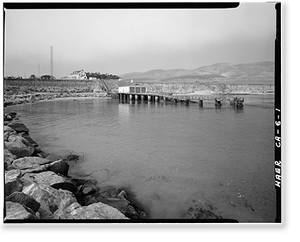 Snapshots of the Past
Vintage Building Photo - Lompoc vicinity, California - Point Arguello (1)
This rare historical print captures Point Arguello Coast Guard Rescue Station, Lompoc vicinity, Santa Barbara County, CA in remarkable detail. Sourced directly from the Library of Congress, it...$57.00 -
 Snapshots of the Past
Historic Architecture - Woodside, California - Store, Kings Mountain
Drawn from the Library of Congress archive, this print depicts Woodside Store, Kings Mountain Road, Woodside, San Mateo County, CA - 3. The Library holds one of the most comprehensive collections of...$57.00 -
 Snapshots of the Past
Antique Architecture - Woodside, California - La Questa Wine Cellar
Drawn from the Library of Congress archive, this print depicts La Questa Wine Cellar, 240 La Questa Road, Woodside, San Mateo County, CA - 3. The Library holds one of the most comprehensive...$57.00 -
 Snapshots of the Past
Historic Architecture - Woodside, California - Green Gables, 329 Albion
This rare historical print captures Green Gables, 329 Albion Avenue, Woodside, San Mateo County, CA - 25 in remarkable detail. Sourced directly from the Library of Congress, it represents an...$57.00 -
 Snapshots of the Past
Vintage Building Photo - Pescadero, California - St. Anthony's Roman
This rare historical print captures St. Anthony's Roman Catholic Church, North Street, Pescadero, San Mateo County, CA - 9 Classic in remarkable detail. Sourced directly from the Library of Congress,...$57.00 -
 Snapshots of the Past
Vintage Building Photo - Pescadero, California - Congregational Church (2)
Step back in time with this striking reproduction of Congregational Church, San Gregorio Street, Pescadero, San Mateo County, CA - 2. Sourced from the United States Library of Congress.Library of...$57.00 -
 Snapshots of the Past
Vintage Building Photo - Pescadero, California - Congregational Church (1)
This rare historical print captures Congregational Church, San Gregorio Street, Pescadero, San Mateo County, CA Classic in remarkable detail. Sourced directly from the Library of Congress, it...$57.00 -
 Snapshots of the Past
Historic Architecture - Pescadero, California - Bartlett V. Weeks (2)
Drawn from the Library of Congress archive, this print depicts Bartlett V. Weeks House, 172 Goulson Street, Pescadero, San Mateo County, CA - 4. The Library holds one of the most comprehensive...$57.00 -
 Snapshots of the Past
Historic Architecture - Pescadero, California - Bartlett V. Weeks (1)
This rare historical print captures Bartlett V. Weeks House, 172 Goulson Street, Pescadero, San Mateo County, CA - 2 in remarkable detail. Sourced directly from the Library of Congress, it represents...$57.00 -
 Snapshots of the Past
Antique Architecture - Menlo Park, California - Church of the Nativity
Drawn from the Library of Congress archive, this print depicts Church of the Nativity, 210 Oak Grove Avenue, Menlo Park, San Mateo County, CA - 20 Classic. The Library holds one of the most...$57.00