
Lighthouses
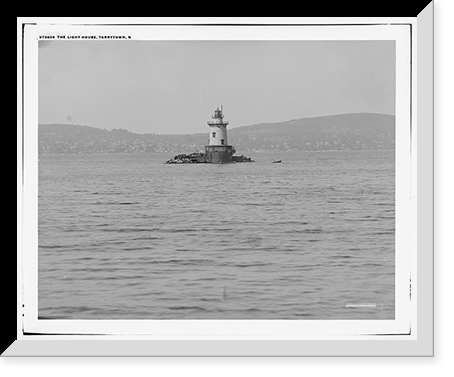
The United States built more than a thousand lighthouses, and for most of the nineteenth century they were badly run. The Treasury put them under a customs official who bought the cheapest lamps available and resisted every improvement, and American lights were notoriously dimmer than European ones for thirty years.
The fix was a Fresnel lens. Augustin-Jean Fresnel worked out in 1822 that a lens could be cut into concentric rings and flattened without losing its focusing power, which let a single lamp be gathered into a beam visible over twenty miles. France had them from the 1820s. The United States mostly did not until the Lighthouse Board was created in 1852 and began importing them in quantity. The lenses in these photographs are furniture-sized objects of ground glass and polished brass, ordered by size from first order down to sixth, and they were the most expensive thing at any station.
The keeper’s job was maintenance more than heroics. The lamp burned whale oil, then lard oil, then kerosene, and every one of them left deposits. A keeper trimmed wicks, polished every prism in the lens, refilled reservoirs through the night, wound the clockwork that rotated the lens, and kept a log. Stations were inspected without warning and graded, and the paint, the brass and the log all counted.
Women held these appointments in real numbers, and the mechanism is worth knowing. A keeper’s wife did the work alongside him, so when he died the Lighthouse Service frequently appointed her rather than train someone new. Dozens of women served that way, some for decades. Ida Lewis at Lime Rock in Newport Harbor took over after her father’s stroke, was credited with numerous rescues, and appeared on the cover of Harper’s Weekly in 1869 — which made her briefly one of the most famous women in America.
A great many of the surviving photographs came from the Service itself. Inspectors documented every station, and the annual reports needed illustrations, so there is a systematic record of towers, dwellings, boathouses, oil houses and fog signal buildings, often photographed from the same angle across decades. That repetition makes them unusually good for showing change.
Automation ended it. Electrification and automatic timers removed the need for a resident keeper through the middle of the twentieth century, the Coast Guard absorbed the Lighthouse Service in 1939, and the last civilian keepers retired in the following decades. Many of the dwellings in these photographs were demolished once nobody lived in them.
Life-saving stations are a related subject filed separately and worth pulling alongside. The Life-Saving Service kept crews of surfmen who patrolled beaches on foot and launched boats into weather that had already wrecked somebody, and it merged with the Revenue Cutter Service in 1915 to become the Coast Guard. Their drill photographs — breeches buoy practice, boat launches through surf — sit naturally with lighthouse imagery.
One dating tip. Daymarks — the painted patterns of stripes, spirals and bands — were assigned so that towers could be told apart in daylight, and they were repainted to new schemes over the years. The pattern often dates the photograph more precisely than anything else in it.
The Roof Was There to Protect the Bridge


-

 Snapshots of the Past
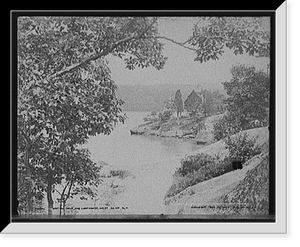
Antique Maritime - Lighthouses - Flirtation Walk and lighthouse
This rare historical print captures Flirtation Walk and lighthouse, United States Military Academy, West Point, N.Y in remarkable detail. Sourced directly from the Library of Congress, it represents...$57.00 -
 Snapshots of the Past
Antique Architecture - Florida - Anastasia Light House at St. Augustine
Drawn from the Library of Congress archive, this print depicts Anastasia Light House at St. Augustine, Fla. The Library holds one of the most comprehensive collections of American and international...$57.00 -
 Snapshots of the Past
Historic Architecture - New Haven - Light House Point
Originally preserved in the Library of Congress, this print of Light House Point, New Haven - 2 is now available for your home or office. The Library has preserved this image as part of its permanent...$57.00 -
 Snapshots of the Past
Antique Architecture - Lighthouses - Palmer Park, light house
Step back in time with this striking reproduction of Palmer Park, light house. Sourced from the United States Library of Congress.Library of Congress record: Created between 1880 and 1899 Date based...$57.00 -
 Snapshots of the Past
Historic Maritime - Florida - Jupiter Inlet from the lighthouse
Drawn from the Library of Congress archive, this print depicts Jupiter Inlet from the lighthouse, Fla. The Library holds one of the most comprehensive collections of American and international...$57.00 -
 Snapshots of the Past
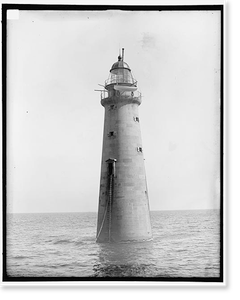
Antique Maritime - Boston, Massachusetts - Minot's Ledge Lighthouse (2)
Drawn from the Library of Congress archive, this print depicts Minot's Ledge Lighthouse, Boston, Mass. - 2. The Library holds one of the most comprehensive collections of American and international...$57.00 -
 Snapshots of the Past
Antique Maritime - Boston, Massachusetts - Minot's Ledge Lighthouse (1)
Drawn from the Library of Congress archive, this print depicts Minot's Ledge Lighthouse, Boston, Mass. The Library holds one of the most comprehensive collections of American and international...$57.00 -
 Snapshots of the Past
Historic Architecture - Lighthouses - Light house, Tarrytown, N.Y
Step back in time with this striking reproduction of Syrian shoemaker. Sourced from the United States Library of Congress.Library of Congress record: Title from unverified data provided by the Bain...$57.00