
Mount Vernon
Mount Vernon is the reason historic preservation exists in America as an organized activity, and the story is not the one most people assume.
By the 1850s the house was falling down. Washington’s descendants could not afford it, the roof leaked, the piazza columns were propped with ships’ masts, and the family offered it to the federal government and then to Virginia. Both declined to buy it.
Ann Pamela Cunningham of South Carolina, who had limited mobility after a riding injury, started a campaign in 1853 addressed to the women of the South and then of the whole country. She organized state by state, appointing a vice regent in each, and raised two hundred thousand dollars in small contributions. The Mount Vernon Ladies’ Association bought the house and two hundred acres in 1858 and has held it ever since. It was the first national preservation effort in the United States and it was run entirely by women at a time when they could not vote and in most states could not hold property in their own names once married.
During the Civil War both armies treated the grounds as neutral. Soldiers came in numbers, from both sides, and the association asked only that they arrive unarmed. Photographs from the 1860s show men in uniform standing on the piazza, and it is not always possible to tell which uniform.
The visitors came by water. Steamboats ran down from Washington to a wharf below the house, which is why so many photographs are taken from the river side looking up the slope. The east front with its two-story piazza facing the Potomac is the view everyone knows, and Washington designed that porch himself. It has no real precedent in the architecture of the period.
The outbuildings are the part of the record that has gotten more attention over time — the kitchen, the smokehouse, the stable, the greenhouse and the quarters where enslaved people lived. More than three hundred people were enslaved at Mount Vernon at Washington’s death. Photographs from the late nineteenth century show these structures in varying states, some rebuilt, some still original, and they are a better source for the working plantation than the house is.
The tomb on the slope below the house is where the family moved his remains in 1831, in accordance with his will, from an earlier vault nearer the river. It became a fixed stop for every visitor with a camera.
Three Parks, a Quarter Million Light Bulbs


-

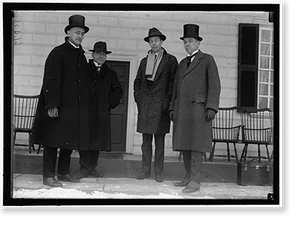 Snapshots of the Past
Antique Portrait - Mount Vernon - Press Correspondents at Serbian
Step back in time with this striking reproduction of PRESS CORRESPONDENTS AT MOUNT VERNON. SERBIAN MISSIONS. PHIL PATCHEN AT RIGHT. Sourced from the United States Library of Congress.Library of...$57.00 -
 Snapshots of the Past
Antique Portrait - Mount Vernon - Serbian Mission to the U.S
Step back in time with this striking reproduction of SERBIAN MISSION TO THE U.S. AT MOUNT VERNON, WITH SEC. LANSING - 8. Sourced from the United States Library of Congress.Library of Congress record:...$57.00 -
 Snapshots of the Past
Historic Portrait - Mount Vernon - Allied Commission to U.S
This rare historical print captures ALLIED COMMISSION TO U.S. AT MOUNT VERNON. IN GROUPS STOLLING ABOUT GROUNDS, MOST IMPORTANT PERSONS ONLY: JOFFRE; CHOCEPRAT; LANSING; VIVIANI; DANIELS in...$57.00 -
 Snapshots of the Past
Historic Portrait - Mount Vernon - Brick yard near
Drawn from the Library of Congress archive, this print depicts Brick yard near Mount Vernon. The Library holds one of the most comprehensive collections of American and international historical...$57.00 -
 Snapshots of the Past
Antique Portrait - Virginia - Brick Yard Near Mount Vernon
This rare historical print captures BRICK YARD NEAR MOUNT VERNON, VA. - 3 in remarkable detail. Sourced directly from the Library of Congress, it represents an authentic piece of documented history...$57.00 -
 Snapshots of the Past
Antique Portrait - Mount Vernon - Brick Yard Below - Historic Wall Art Gift
Drawn from the Library of Congress archive, this print depicts BRICK YARD BELOW MOUNT VERNON - 2 Classic. The Library holds one of the most comprehensive collections of American and international...$57.00 -
 Snapshots of the Past
Antique Portrait - Mount Vernon - Brick Yard Below
This rare historical print captures BRICK YARD BELOW MOUNT VERNON in remarkable detail. Sourced directly from the Library of Congress, it represents an authentic piece of documented history.Library...$57.00 -
 Snapshots of the Past
Antique Architecture - Mount Vernon, Virginia - Mansion and grounds
This rare historical print captures Mansion and grounds, Mount Vernon, Va in remarkable detail. Sourced directly from the Library of Congress, it represents an authentic piece of documented history...$57.00 -
 Snapshots of the Past
Historic Photo Print - Mount Vernon, Virginia - Parlor
Originally preserved in the Library of Congress, this print of Parlor, Mount Vernon, Va is now available for your home or office. The Library has preserved this image as part of its permanent...$57.00 -
 Snapshots of the Past
Black & White Photo - Mount Vernon, Virginia - Woodlawn, home of Nelly
Step back in time with this striking reproduction of Woodlawn, home of Nelly Custis Lewis, Mount Vernon, Va. - 2. Sourced from the United States Library of Congress.Library of Congress record:...$57.00