
Opera Houses
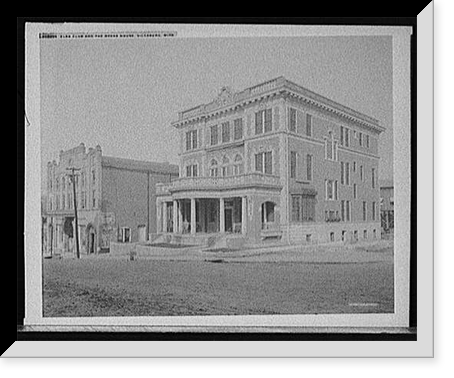
Almost no opera was performed in an American opera house. The name was aspirational and slightly defensive — a theater was a disreputable thing in much of nineteenth-century America, and an opera house was respectable.
There were something like five thousand of them by 1900, in towns of every size, and most followed the same plan: commercial space on the ground floor, the hall upstairs, a flat floor with removable seating, a stage with a painted drop curtain, and a gallery. The building frequently belonged to a local businessman who put his own name on it.
What they actually hosted was everything the town did indoors. Touring melodrama and minstrel companies. Lecturers on the Chautauqua and Lyceum circuits. High school graduations. Political rallies. Basketball. Dances. Boxing. Roller skating, when the floor came out. Traveling magicians, hypnotists, and men who claimed to have been to the Arctic.
The Chautauqua circuit deserves a note of its own. From the 1870s a network of lecturers, musicians and readers toured these same halls on organized seasons, selling self-improvement to small towns that had no other access to it. Theodore Roosevelt called it the most American thing in America, and for forty years an opera house in a town of two thousand could host a serious lecture on any Tuesday.
The circuit made it work. A company left New York or Chicago and played one-night stands across a state, moving by rail overnight, and the opera house was the fixed point in every town that made that possible. The scale of the touring business was extraordinary — hundreds of companies on the road at once, each carrying its own scenery.
The painted drop curtain is the detail worth looking for and it is nearly always in the photographs. Almost every hall had one, usually showing a Venetian canal or a Swiss lake or a Roman ruin, and the border was sold as advertising space to local merchants. So a curtain painted with an idealized European landscape carried the names of the hardware store and the undertaker around its edge.
The scenery was standard and shipped by rail. A touring company carried a set of drops that could be arranged as a parlor, a garden, a prison or a forest, and every opera house was built to a rough standard of stage depth and grid height so that the same scenery would hang anywhere on the circuit. It was a national theatrical infrastructure that nobody planned.
The end came fast. Motion pictures arrived, and a building that needed a touring company and a full house to break even could not compete with a projector and a boy to run it. Most opera houses were converted to cinemas in the 1910s and 1920s, then closed, then used for storage. A great many are still standing above the storefronts of American main streets with the seating still in place upstairs.
For anyone reading the photographs, the exterior often hides the hall entirely. The building looks like a commercial block because it was one, and the only sign of the theater is a second-floor entrance and a marquee.
The Bell, the Horses, and the Machine They Pulled


-

 Snapshots of the Past
Antique Architecture - Detroit, Michigan - Whitney Opera House
Step back in time with this striking reproduction of Whitney Opera House, Detroit, Mich. Sourced from the United States Library of Congress.Library of Congress record: Created between 1900 and 1906...$57.00 -
 Snapshots of the Past
Vintage Building Photo - New Orleans - French Opera House
Step back in time with this striking reproduction of French Opera House, New Orleans. Sourced from the United States Library of Congress.Library of Congress record: Created c1900 Negative broken...$57.00 -
 Snapshots of the Past
Vintage Building Photo - Vicksburg, Mississippi - Elks Club
This rare historical print captures A. Sato and wife in remarkable detail. Sourced directly from the Library of Congress, it represents an authentic piece of documented history.Library of Congress...$57.00