
Washington Monument
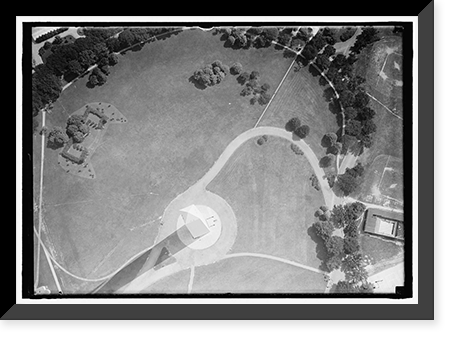
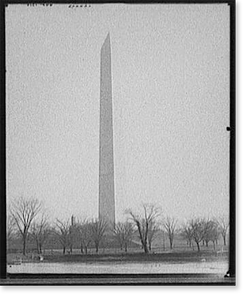
For twenty-two years the Washington Monument was a stump. That fact explains most of the photographs.
Construction began in 1848 with private subscription money and ran out of it in 1854, at which point the shaft stood at about a hundred and fifty feet. It stayed that way through the Civil War and beyond \u2014 an unfinished tower in the middle of Washington with cattle grazing around the base. Mark Twain called it a factory chimney with the top broken off.
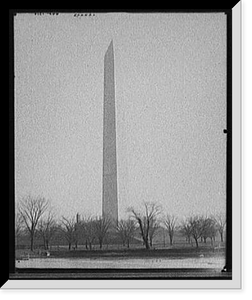
The break is visible in the finished monument and worth looking for. The marble came from a different quarry when work resumed in 1879, and the color changes at that height. It is obvious in raking light and in most photographs.
The stoppage had a political cause. The Know-Nothing party seized control of the building society in 1854 in a dispute over a stone donated by the Pope, and public subscriptions collapsed. The memorial stones set into the interior walls \u2014 sent by states, cities, foreign governments and private societies \u2014 are a peculiar record of who wanted to be associated with Washington and when.
The Army Corps of Engineers finished it under Thomas Casey, who reinforced the foundation while the shaft stood on it, which was not a trivial piece of work. It was completed in 1884 at just over five hundred and fifty feet, making it the tallest structure in the world for five years until the Eiffel Tower.
The original design was far more elaborate. Robert Mills proposed a circular colonnaded temple at the base with a statue of Washington driving a chariot. It was dropped for cost, which is why the monument is a plain obelisk and much better for it.
The elevator is a subject in its own right. Early on it took twenty minutes to reach the top by steam and women were advised to take the stairs on the grounds that the ride was unsafe, while men rode. The nine hundred steps were the alternative.
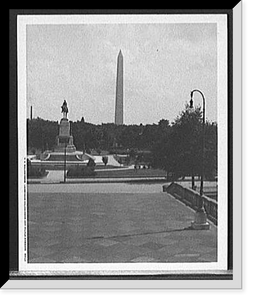
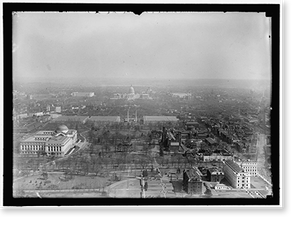
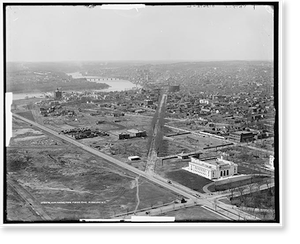
For dating, the grounds are the guide. The Mall was informal parkland well into the twentieth century, with trees, a railway station and a canal, and the open sweep people now expect is a product of the 1901 McMillan plan carried out over decades.
The capstone is aluminum, which sounds odd until you know that in 1884 aluminum was a precious metal costing about as much as silver. The hundred-ounce pyramid at the summit was the largest single piece of aluminum then cast, and it was displayed at Tiffany in New York before being installed.
The scale is deliberately hard to read from photographs. There is nothing on the shaft to give a sense of size — no windows, no courses, no ornament — which is exactly what an obelisk is supposed to do. Photographs that include people at the base are the ones worth having.
The Egyptian precedent was deliberate and slightly awkward. An obelisk is a pharaonic form, and choosing it for a republican memorial required some argument at the time. What settled it was that an obelisk needed no explanation and would not date, which has proved correct.
The Cog Railway and the Worst Weather in America




-

 Snapshots of the Past
Antique Portrait - Washington Monument - View of Mall From Monument
Step back in time with this striking reproduction of WASHINGTON MONUMENT. VIEW OF MALL FROM MONUMENT. Sourced from the United States Library of Congress.Library of Congress record: Created between...$57.00 -
 Snapshots of the Past
Antique Architecture - Washington Monument - View of and Mall
Drawn from the Library of Congress archive, this print depicts View of Washington Monument and Mall Classic. The Library holds one of the most comprehensive collections of American and international...$57.00 -
 Snapshots of the Past
Vintage Building Photo - Washington Monument - Wash
Drawn from the Library of Congress archive, this print depicts Washington Monument, Wash., D.C. The Library holds one of the most comprehensive collections of American and international historical...$57.00 -
 Snapshots of the Past
Antique Architecture - Richmond, Virginia - Washington Monument
This rare historical print captures Washington Monument and City Hall, Richmond, Va. Classic in remarkable detail. Sourced directly from the Library of Congress, it represents an authentic piece of...$57.00 -
 Snapshots of the Past
Historic Architecture - Washington Monument - Washington
Originally preserved in the Library of Congress, this print of Washington from the Monument i.e. Washington Monument - 4 is now available for your home or office. The Library has preserved this image...$57.00 -
 Snapshots of the Past
Historic Architecture - Baltimore - Washington Monument
Step back in time with this striking reproduction of Washington Monument, Baltimore. Sourced from the United States Library of Congress.Library of Congress record: Created c1902 WHJ 262-02" on...$57.00 -
 Snapshots of the Past
Vintage Military Print - Richmond - Virginia. Washington monument
Step back in time with this striking reproduction of Richmond Virginia. Washington monument. Sourced from the United States Library of Congress.Library of Congress record: Created 1865 Title from...$57.00 -
 Snapshots of the Past
Antique Architecture - Washington, DC - Monument - Antique Wall Decor Print
Step back in time with this striking reproduction of Alderman at 46th St. Dam. Sourced from the United States Library of Congress.Library of Congress record: Title from unverified data provided by...$57.00 -
 Snapshots of the Past
Historic Architecture - Washington, DC - Sherman statue and Monument
This rare historical print captures Jess Willard - 6 in remarkable detail. Sourced directly from the Library of Congress, it represents an authentic piece of documented history.Library of Congress...$57.00