World's Fairs

A world's fair was a complete city, built at enormous expense, occupied by millions of people for a single summer, and then demolished. That is the fact that makes the photographs valuable: they are all that remains.
The Columbian Exposition in Chicago in 1893 set the pattern and remains the most consequential. Daniel Burnham assembled the leading architects in the country and imposed a single classical style, a uniform cornice line and a uniform color — white — across a set of enormous temporary buildings on reclaimed swampland. Twenty-seven million people came, at a time when the national population was sixty-three million.
The buildings were not stone. They were staff — plaster and hemp fiber over wood frames — which is why they could be built in three years and why nothing survives. The White City was a stage set at the scale of a city, and everyone knew it.
Its influence was out of all proportion. The City Beautiful movement, the classical courthouses and libraries and railway stations built across America for the next thirty years, the very idea that a city ought to be planned — all of it traces to a fair that lasted six months.
The Midway Plaisance is the other half and the more honest one. A mile-long strip of concessions running off the main grounds, with the first Ferris wheel, dancers, a captive balloon, and a series of ethnological villages that displayed human beings from around the world as exhibits. The fairs did this routinely and the photographs record it plainly. It was popular, it was profitable, and it was exactly what it looks like.
The fairs also functioned as product launches at national scale. The telephone, the elevator, the Ferris wheel, shredded wheat, the ice cream cone, air conditioning, television and nylon all reached the American public through an exposition. A photograph of a crowd around an exhibit is frequently a photograph of people seeing a thing for the first time.
The later fairs each had a character. Buffalo in 1901, where McKinley was shot. St. Louis in 1904, the largest of them all. San Francisco in 1915, built to announce the city had recovered from the earthquake. Chicago again in 1933 and New York in 1939, both looking forward rather than back — streamlined, colored, industrial, and full of promises about the future that the following six years made painful.
The scale of attendance is the thing hardest to picture now. St. Louis in 1904 drew nearly twenty million admissions across seven months to a site of twelve hundred acres, with over fifteen hundred buildings on it. Nothing in American public life has approached that since, and every one of those buildings came down afterward.
The photography is unusually good throughout, because the fairs hired official photographers and because the exhibition halls were lit for display. Night views are common from 1893 onward, and electric illumination was itself one of the exhibits.
One thing to watch for. Official photographs show the buildings empty at dawn to make them look monumental. The crowd pictures are the more interesting ones.
The Building Every Small Town Was Proud Of




-

 Snapshots of the Past
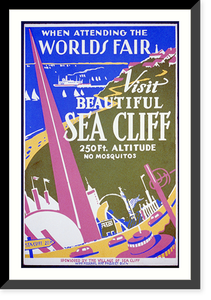
Historic Photo Print - World's Fairs - When attending the World's Fair (1)
Originally preserved in the Library of Congress, this print of When attending the World's Fair, visit beautiful Sea Cliff 250 ft. altitude : No mosquitos is now available for your home or office. The...$57.00 -
 Snapshots of the Past
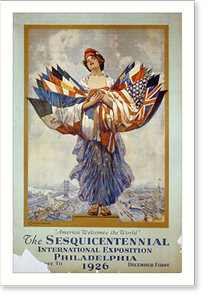
Black & White Photo - Philadelphia - America Welcomes the World, 1926
Drawn from the Library of Congress archive, this print depicts America Welcomes the World". The Sesquicentiennial International Exposition Philadelphia, June first to December first, 1926". The...$57.00 -
 Snapshots of the Past
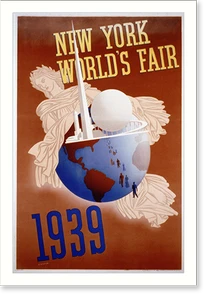
Vintage Photo Print - New York City - New York World's Fair, 1939
Step back in time with this striking reproduction of New York World's Fair 1939. Sourced from the United States Library of Congress.Library of Congress record: Created 1939 Color offset by John C...$57.00 -
 Snapshots of the Past
Vintage Americana Print - Chicago - world's fair, 1833
Step back in time with this striking reproduction of Chicago world's fair. A century of progress, 1833-1933.Weimer Pursell. Sourced from the United States Library of Congress.Library of Congress...$57.00 -
 Snapshots of the Past
Vintage Photo Print - Chicago - World's Fair, A Century, 1833 (1)
Drawn from the Library of Congress archive, this print depicts World's Fair, Chicago. A Century of Progress, 1833-1933.Sheffer. - 2. The Library holds one of the most comprehensive collections of...$57.00 -
 Snapshots of the Past
Black & White Photo - Cincinnati - Eleventh Industrial Exposition, 1883
Step back in time with this striking reproduction of Eleventh Cincinnati Industrial Exposition, 1883 - 2. Sourced from the United States Library of Congress.Library of Congress record: Created...$57.00 -
 Snapshots of the Past
Vintage Photo Print - San Francisco - Panama-Pacific, 1915
Step back in time with this striking reproduction of Panama-Pacific International Exposition, San Francisco, Cal, 1915. Sourced from the United States Library of Congress.Library of Congress record:...$57.00 -
 Snapshots of the Past
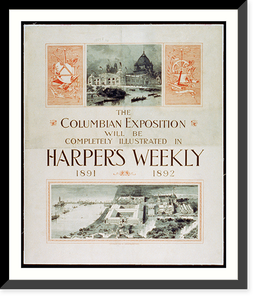
Vintage Photo Print - World's Fairs - The Columbian Exposition, 1891
Originally preserved in the Library of Congress, this print of The Columbian Exposition will be completely illustrated in Harper's Weekly, 1891, 1892 is now available for your home or office. The...$57.00 -
 Snapshots of the Past
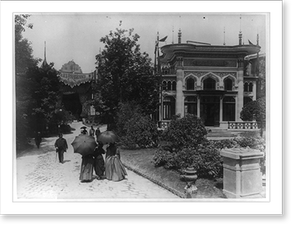
Vintage Americana Print - World's Fairs - Turkish Tobacco, 1889
Originally preserved in the Library of Congress, this print of Turkish Tobacco Pavilion with Folies Parisiennes on left, Paris Exposition, 1889 is now available for your home or office. The Library...$57.00 -
 Snapshots of the Past
Black & White Photo - Chicago, Illinois - Figure of I Will
Drawn from the Library of Congress archive, this print depicts Figure of I Will, in archway above entrance, Chicago Day, World's Columbian Exposition, Chicago, Ill. The Library holds one of the most...$57.00 -
 Snapshots of the Past
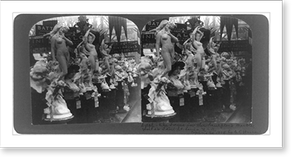
Black & White Photo - St. Louis - Sylph-like forms in the sculptor's
Step back in time with this striking reproduction of Sylph-like forms in the sculptor's marble, World's Fair, St. Louis, U.S.A. Sourced from the United States Library of Congress.Library of Congress...$57.00 -
 Snapshots of the Past
Vintage Americana Print - World's Fairs - The United States, 1900
Originally preserved in the Library of Congress, this print of The United States Pavillon sic, Paris Exposition of 1900 is now available for your home or office. The Library has preserved this image...$57.00