
Yellowstone
Yellowstone is the first national park anywhere, signed into existence in March 1872, and it exists in large part because of pictures.
The Hayden Survey went into the region in 1871 carrying two people whose work was not scientific. William Henry Jackson hauled a wet-plate camera and a portable darkroom over the mountains, because wet plates have to be coated, exposed and developed within about ten minutes. Thomas Moran went along and painted. When Congress debated the bill the following winter, Jackson’s photographs and Moran’s watercolors were put in front of members who had heard the stories about boiling ground and geysers and assumed they were tall tales. The pictures settled it.
For its first fourteen years the park had almost no management, and poaching and vandalism were bad enough that in 1886 the Army took over. Soldiers ran Yellowstone for thirty-two years from Fort Yellowstone at Mammoth Hot Springs, and the stone buildings they put up are still the park headquarters. Photographs of cavalry patrols in the geyser basins are a common and slightly surreal part of the record.
The Northern Pacific Railroad built the traffic. The line reached Livingston in 1883 and a branch ran to Gardiner at the north edge, and the railroad then promoted the park hard in posters and photographs because every visitor was a ticket. The stone arch at the Gardiner entrance went up in 1903 with Theodore Roosevelt on hand to lay the cornerstone.
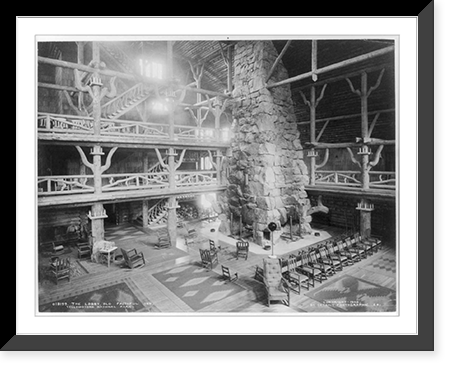
The Old Faithful Inn opened in 1904, built through a Wyoming winter out of local lodgepole pine and rhyolite, with a lobby seven stories tall and a chimney holding eight fireplaces. It is one of the largest log structures ever built and it was designed to look like something that had grown there rather than something ordered from a catalog.
The color images of the hot springs are worth understanding. Photochroms — Detroit Publishing’s process — were made by transferring a black-and-white negative onto lithographic stones and printing in layers of color chosen by hand. So these are color pictures made before color photography, and the blues and oranges of the springs are somebody’s informed judgment rather than a measurement. They are also, in many cases, remarkably close.
Bear-feeding platforms, coaches full of tourists in dusters, soldiers on skis in winter, the terraces at Mammoth before the flow shifted — the park was photographed as a destination from the very beginning, because that was the point of it.
Carleton Watkins Made the Case


-

 Snapshots of the Past
Historic Landscape - Yellowstone - Lower Falls
This rare historical print captures Lower Falls of Yellowstone in remarkable detail. Sourced directly from the Library of Congress, it represents an authentic piece of documented history.Library of...$57.00 -
 Snapshots of the Past
Vintage Building Photo - Yellowstone - Wild elk at Tower Falls
Drawn from the Library of Congress archive, this print depicts Wild elk at Tower Falls, Yellowstone National Park. The Library holds one of the most comprehensive collections of American and...$57.00