
Thanksgiving
Thanksgiving is a national holiday because one woman would not stop writing letters.
Sarah Josepha Hale edited Godey’s Lady’s Book, the most widely read magazine in the country, and from 1846 she pushed in print and in private correspondence for a single national day of thanksgiving. She wrote to five presidents over thirty-six years. Lincoln was the one who agreed, in October 1863, after Gettysburg and Vicksburg, proclaiming the last Thursday in November — and his reasoning was explicitly about a fractured country needing something to do together.
The date then stayed a matter of presidential proclamation rather than law, which caused the strangest episode in the holiday’s history. In 1939 the last Thursday fell on November 30, leaving a very short shopping season, and retailers asked Franklin Roosevelt to move it up a week. He did. About half the states refused to follow, so for three years the country observed Thanksgiving on two different days depending on where you lived, with families split across state lines and college football schedules in chaos. The press called the earlier date Franksgiving. Congress ended it in 1941 by fixing the fourth Thursday in law.
Football is older on this holiday than most people assume. The first Thanksgiving Day intercollegiate championship was played in 1876, and by the 1890s the Princeton–Yale game in New York was the event of the social season, drawing forty thousand people and closing shops. High schools and colleges everywhere copied it. A very large share of the Thanksgiving photographs in any American archive are football photographs.
The parades came later than people think and not from where they think. Gimbels ran one in Philadelphia in 1920. Macy’s started in New York in 1924 with employees marching and animals borrowed from the Central Park Zoo; the balloons arrived in 1927, and for several years they were released at the end and offered a reward to whoever mailed them back.
The custom that has vanished entirely is Ragamuffin Day. Children in New York and other eastern cities dressed as beggars and tramps, blacked their faces with cork, and went door to door and along the streets asking “anything for Thanksgiving?” for pennies, fruit or candy. It ran from the 1870s into the 1930s and was enormous. Photographs of masked and costumed children on Thanksgiving morning are not mislabeled Halloween pictures. Reformers spent two decades trying to end it, on the grounds that it taught begging, and it was largely folded into Halloween by the end of the 1930s.
The food photographs are worth reading carefully. Turkey was standard by the 1860s, but the rest of the table in period pictures and printed menus is broader and stranger than the modern spread — oysters at the start, several roasted meats rather than one, and mince pie appearing at least as often as pumpkin. Charity dinners for the poor were photographed heavily every year, because the newspapers wanted the picture.
The Plymouth story attached itself to the holiday late. The 1621 harvest gathering was not a recurring observance and did not enter the popular account until the nineteenth century, when it was pulled forward to give a young national custom an ancient-looking origin. Photographs of school pageants with paper collars and construction-paper headdresses are documenting that invention rather than the event.
The Insult Cards Outsold the Romantic Ones




-

 Snapshots of the Past
Black & White Photo - Thanksgiving, 1919 - Historic Wall Art Gift
Step back in time with this striking reproduction of Thanksgiving, 1919 - 4. Sourced from the United States Library of Congress.Library of Congress record: Created 1919 Title from unverified data...$57.00 -
 Snapshots of the Past
Black & White Photo - Thanksgiving, 1919 - Great Gift for History Buffs
This rare historical print captures Thanksgiving, 1919 - 3 Classic in remarkable detail. Sourced directly from the Library of Congress, it represents an authentic piece of documented history.Library...$57.00 -
 Snapshots of the Past
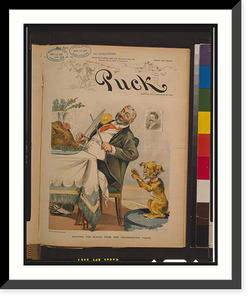
Vintage Photo Print - Thanksgiving - Waiting for scraps
Step back in time with this striking reproduction of Waiting for scraps from the Thanksgiving table.Dalrymple. Sourced from the United States Library of Congress.Library of Congress record: Created...$57.00 -
 Snapshots of the Past
Vintage Americana Print - Thanksgiving - The first J.L.G. Ferris, 1621 (2)
This rare historical print captures The first Thanksgiving 1621.J.L.G. Ferris. - 2 in remarkable detail. Sourced directly from the Library of Congress, it represents an authentic piece of documented...$57.00 -
 Snapshots of the Past
Historic Photo Print - Thanksgiving - Sunset, November, 1903
Historic Framed Print, Sunset, November 1903. Thanksgiving number.Sheridan., 17-7/8" x 21-7/8", Image: 16" x 20"Beautiful historic reproduction print from the Library of Congress collections...$57.00 -
 Snapshots of the Past
Black & White Photo - Thanksgiving - The Chap Book. no.Will H Bradley (2)
This rare historical print captures The Chap Book. Thanksgiving no..Will H Bradley. - 3 Classic in remarkable detail. Sourced directly from the Library of Congress, it represents an authentic piece...$57.00 -
 Snapshots of the Past
Black & White Photo - Thanksgiving - The Chap Book. no.Will H Bradley (1)
This rare historical print captures The Chap Book. Thanksgiving no..Will H Bradley. - 2 in remarkable detail. Sourced directly from the Library of Congress, it represents an authentic piece of...$57.00 -
 Snapshots of the Past
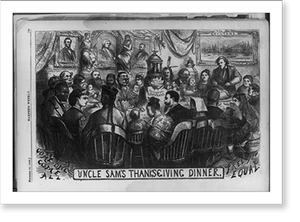
Vintage Photo Print - Thanksgiving - Uncle Sam's dinner
Step back in time with this striking reproduction of Uncle Sam's Thanksgiving dinner. Sourced from the United States Library of Congress.Library of Congress record: Created 1869 Wood engraving by...$57.00 -
 Snapshots of the Past
Antique Photo Print - Thanksgiving - Was your family all together
Originally preserved in the Library of Congress, this print of Was your family all together for Thanksgiving? is now available for your home or office. The Library has preserved this image as part of...$57.00 -
 Snapshots of the Past
Antique Photo Print - Thanksgiving - Harper's Bazaar, number
This rare historical print captures Harper's Bazaar, Thanksgiving number in remarkable detail. Sourced directly from the Library of Congress, it represents an authentic piece of documented history...$57.00 -
 Snapshots of the Past
Vintage Photo Print - Thanksgiving - The beggar boy's
Step back in time with this striking reproduction of The beggar boy's Thanksgiving. Sourced from the United States Library of Congress.Library of Congress record: Created c1871 Stereo by Weller. This...$57.00 -
 Snapshots of the Past
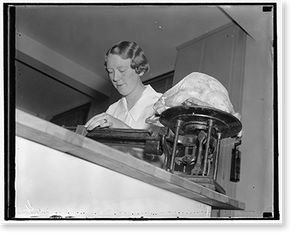
Antique Portrait - Correct way to bake turkey - Vintage Home Decor Print
Originally preserved in the Library of Congress, this print of Correct way to bake turkey. (4) In this very scientific kitchen each bird is weighed before it goes into the oven as a difference in...$57.00